
Deerfield Beach: Functional Mobility Training
You feel it in small moments first. You pause before lifting a grocery bag out of the trunk. You reach for a plate on a high shelf and your shoulder complains. You stand up after sitting for a while and need a few careful steps before your body feels ready.
Many individuals assume that means they need to stretch more, walk more, or just “keep moving.” Sometimes that helps. Often it doesn't, because the core problem isn't merely tight muscles or weak muscles. It's that your body has lost some of its ability to move well, control that movement, and trust it under real-life demands.
That's where functional mobility training comes in. It's a clinical approach to helping you bend, reach, step, turn, lift, and recover your balance with more confidence and less strain. For people dealing with arthritis, old injuries, post-surgical stiffness, back pain, or the effects of aging, that difference matters. The goal isn't to make you better at exercise for exercise's sake. The goal is to help daily life feel easier again.
Moving Through Life With Ease Not Effort
A lot of patients describe the same pattern. They aren't trying to run a marathon. They just want to get through the day without planning every movement. They want to climb stairs without pulling on the railing, get out of the car without bracing first, or walk on uneven ground without feeling unsteady.
That loss of ease can creep up slowly. A person with knee arthritis may stop squatting to reach lower cabinets. Someone recovering from an auto accident may avoid turning quickly because the body still feels guarded. A grandparent may stop getting down on the floor with the kids because getting back up feels uncertain.
Movement problems often show up as “I'm being careful now,” long before they show up as “I can't do this.”
That hesitation is important. It tells us the body isn't organizing movement efficiently anymore. Joints may be stiff, but stiffness is only part of the story. Muscles may be weaker, but weakness alone usually doesn't explain why a simple reach, pivot, or step-down feels awkward or risky.
Why basic exercise often falls short
A random stretching routine might improve how loose you feel for a little while. A basic gym program might make some muscles stronger. But daily life asks for more than isolated flexibility or strength.
You need to shift weight, control your trunk, react to the floor under you, and move through several directions without pain or loss of balance. That's why a more targeted approach works better for many people with pain, injuries, or age-related changes.
What patients usually notice first
The earliest wins are often practical, not dramatic:
- Standing up more smoothly: chairs, couches, and toilets feel less challenging.
- Reaching with less guarding: overhead and across-body motions feel less threatening.
- Walking with more rhythm: your steps feel less stiff and more natural.
- Turning with confidence: you don't feel like you have to move in slow motion.
Those are meaningful signs that your movement system is becoming more coordinated, not just more active.
What Functional Mobility Training Really Is
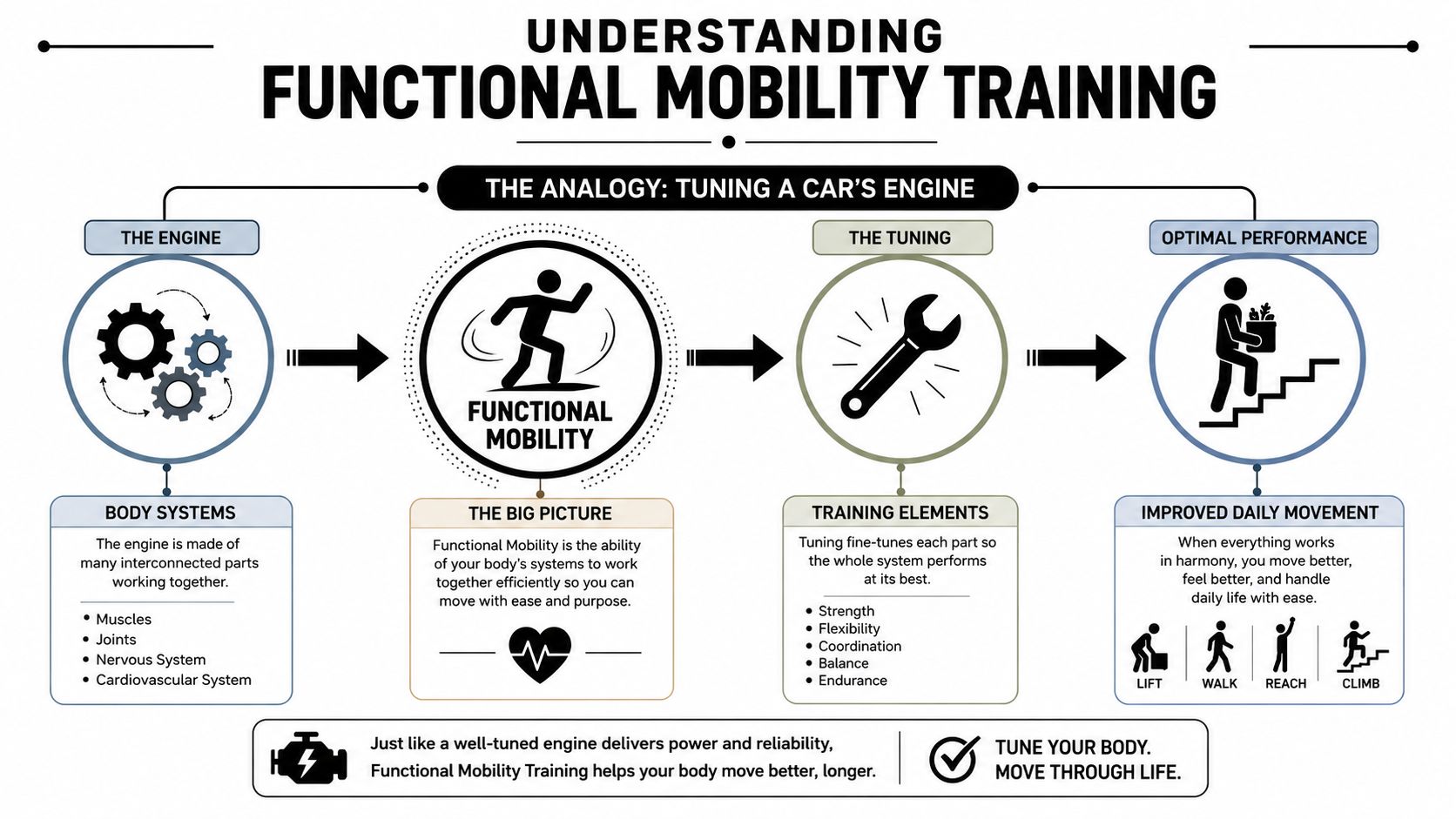
Functional mobility training is the combination of mobility, strength, balance, and control applied to real movement. The easiest way to understand it is to think about a car. More horsepower doesn't help much if the steering is off, the suspension is unstable, and the engine isn't tuned properly.
Your body works the same way. You can be strong and still move poorly. You can be flexible and still feel unstable. The goal is to make the whole system work together.
The three parts that matter most
First, there's range of motion. Your joints and soft tissues need enough freedom to let you squat, rotate, reach, and step without compensating.
Second, there's strength through that range. It isn't enough to reach a position. You need the muscular support to own that position safely.
Third, there's neurological control. That means your brain and body can coordinate timing, alignment, and balance while you move. If you've ever said, “I'm not weak, I just don't feel steady,” this is usually the missing piece. If you want a deeper look at how movement patterns are retrained, this overview of neuromuscular reeducation is a useful next read.
How it differs from stretching or lifting weights
Stretching helps one piece of the puzzle. General strength training helps another. Functional mobility training connects the pieces.
A hamstring stretch may improve how your legs feel. It won't automatically teach you how to hinge at the hips while keeping your back supported. A leg press may build force. It won't necessarily help you step sideways, catch yourself when you lose balance, or rotate to load groceries into the car.
Practical rule: If an exercise doesn't improve how you move outside the clinic or gym, it's incomplete for rehab.
That's why effective functional mobility training has to be individualized and integrated across flexibility, core, balance, strength, and power in multiple movement planes, while progressing toward real-life actions like push, pull, squat, lunge, and rotate, as outlined in this summary of functional training principles.
What good programming looks like
Good programs don't throw random drills together. They progress logically. They match the person in front of us, not a generic fitness template.
That may include:
- Context-specific movement: carrying, reaching, stepping, turning, and floor transitions.
- Multi-planar work: not just forward and backward, but side-to-side and rotational control.
- Gradual loading: enough challenge to create change, without pushing into a flare-up.
- Real object interaction: medicine balls, resistance bands, steps, cones, or household items that make movement practical.
If you're comparing care models, some patients also like reviewing broader mobility therapy options to understand how different clinics blend hands-on treatment with corrective exercise.
Who Can Functional Mobility Training Help
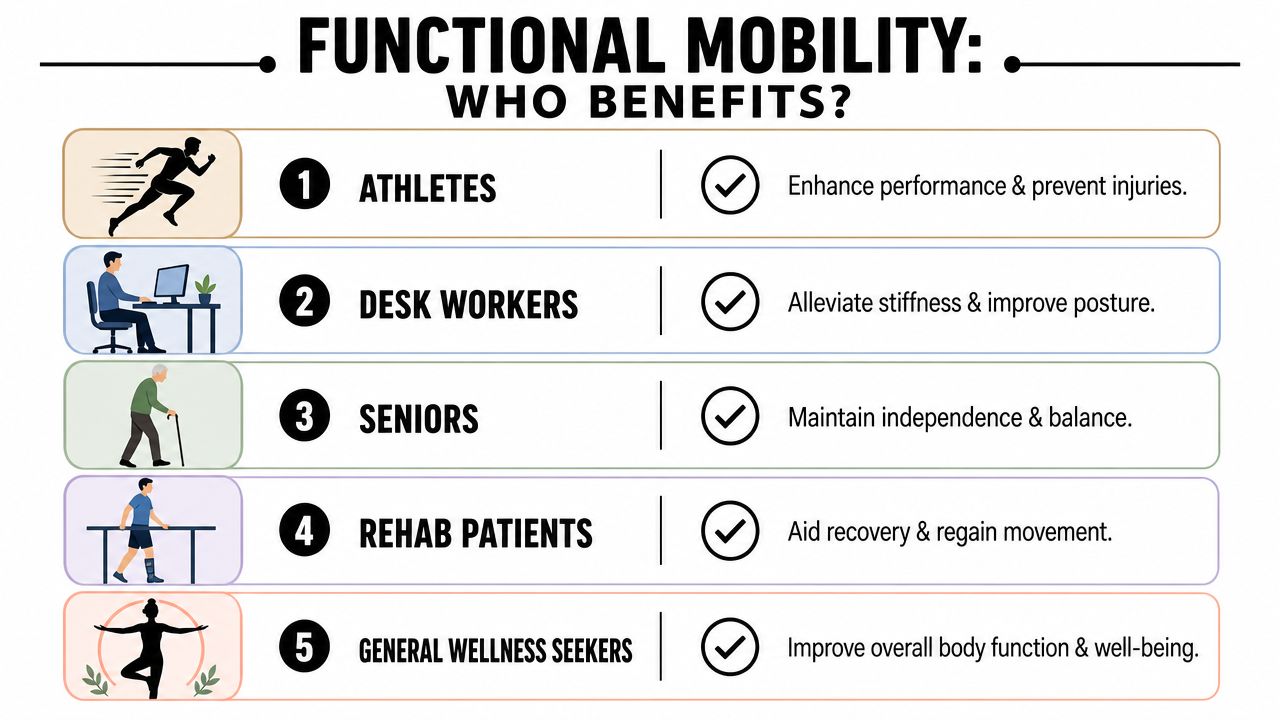
Functional mobility training helps people who don't fit neatly into a single fitness category. It's useful when the problem is less about one weak muscle and more about how the whole body moves under everyday demands.
People dealing with arthritis and chronic pain
This group often gets vague advice: stay active, stretch, strengthen. The hard part is knowing how to do that without irritating joints or feeding compensation patterns. One underserved issue in current guidance is that many resources still don't clearly explain how functional mobility differs from general strength training for older adults with chronic pain, even though the source material provided notes that neurological control of flexibility, not just range of motion, is the critical factor and that integrated strength-plus-mobility training improved postural stability in older adults with mobility limitations, while practical dosage and modifications remain poorly explained in common guides, especially for arthritis and post-auto accident patients, according to this cited source summary.
For someone with arthritis, that usually means choosing controlled movement quality over aggressive stretching, and building support around the joint before asking it to do more.
Seniors focused on balance and independence
Many older adults don't care whether a program looks athletic. They care whether they can get around safely, recover from a misstep, and stay independent.
That's why balance training for seniors shouldn't stop at standing still near a countertop. It should include stepping, turning, weight shifts, and safe practice with real-life tasks. If that's your focus, these mobility exercises for older adults can help you see how mobility work fits into day-to-day function. Families also benefit from reading about strategies for enhanced senior well-being when home support and movement goals need to work together.
People recovering after surgery
After a joint replacement or orthopedic procedure, strength matters, but timing and mechanics matter just as much. Patients often regain basic motion before they regain trust in the limb.
Functional mobility training helps bridge that gap. It retrains transitions, uneven loading, step control, and confidence during daily tasks, so recovery carries over into home and community life.
People recovering from auto or work injuries
After an accident, the body often becomes protective. You may move more slowly, avoid rotation, or brace through simple tasks because your nervous system still reads movement as unsafe.
These patients usually need more than isolated strengthening. They need graded exposure to bending, reaching, carrying, and turning so the body can relearn efficient movement without excess guarding.
Active adults and athletes
Athletes benefit too, especially when they feel “tight” in ways that stretching doesn't solve. Sometimes the issue is poor control at end range, limited hip rotation, or weak transfer between the trunk and extremities.
In those cases, mobility training improves mechanics and can clean up movement patterns that keep getting overloaded.
The Proof Behind Better Movement
Functional mobility training isn't just a trendier name for exercise. It has measurable effects on tasks that matter in daily life.
One strong example comes from a multicomponent program built around muscle power and interval endurance exercise. In that research, participants significantly improved Timed Up and Go performance, with a 7.43 second reduction in fall risk-related TUG performance compared with control groups (95% CI: 3.28–11.59, p < 0.001), and they also improved walking speed over 10 meters by 5.19 seconds at usual pace (p = 0.004) and 4.43 seconds at maximum speed (p = 0.002), as reported in this clinical study on functional mobility training.
What that means in real life
The Timed Up and Go test sounds technical, but the movement is familiar. Stand up from a chair, walk, turn, come back, and sit down. That sequence shows up all day long.
When a person improves there, we usually expect practical carryover such as:
- Safer transfers: getting up from a chair or toilet with less hesitation
- Better turning control: fewer stutter steps when changing direction
- More efficient walking: less shuffling and fewer pauses to regain balance
- Lower fear during movement: more confidence with everyday tasks
Better movement isn't only about pain reduction. It's also about how quickly and safely you can respond when life asks you to stand, turn, reach, or catch yourself.
Why multicomponent programs work
The key phrase in that study is multicomponent. Patients do best when training reflects real movement demands instead of chasing one physical quality in isolation.
A plan that combines power, endurance, coordination, and task-specific practice tends to help more than a plan built around stretching alone or machine-based strengthening alone. That's especially true when someone's goal is not just to exercise, but to walk better, react better, and move with less effort.
The Building Blocks of a Functional Session
A good functional mobility session has structure. It isn't random, and it isn't just a list of stretches followed by a few strength exercises. Each part should prepare you for the next part.
Start with preparation, not punishment
The opening phase should reduce stiffness and improve access to movement. That often includes dynamic drills rather than long passive holds.
Think hip openers, thoracic rotation work, ankle mobility drills, and controlled spinal movement that stays within a comfortable range. If hip restriction is part of your problem, these LifeWorks Integrative Health hip exercises offer examples of how focused mobility work can support better stepping and squatting mechanics.
Build strength in patterns, not just muscles
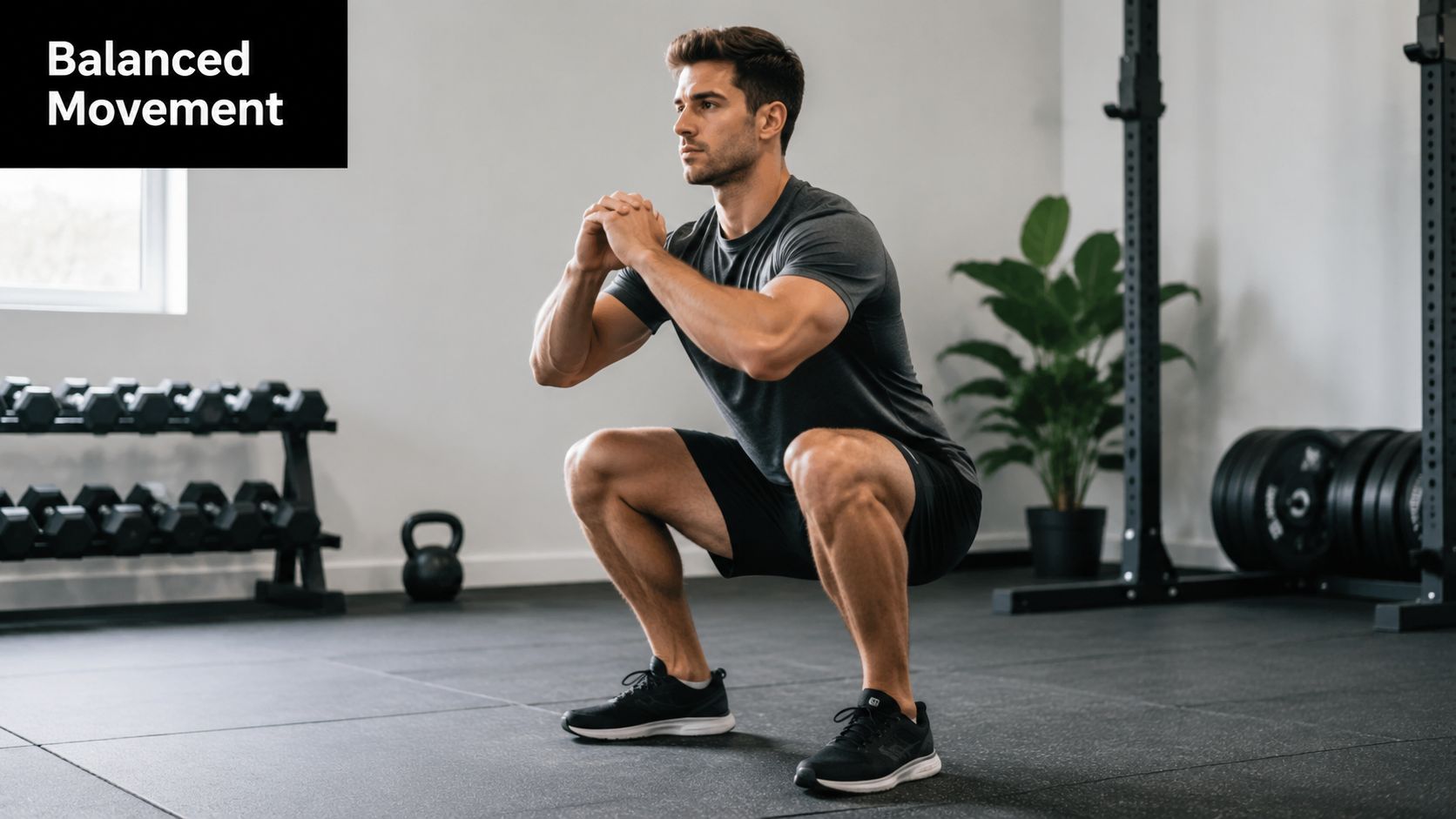
The middle of the session usually shifts into loaded movement patterns. Here, we reinforce squatting, hinging, lunging, carrying, pushing, and pulling with good alignment.
For someone with pain, that might mean a shallow squat to a box, a supported split squat, or a light farmer carry. For a higher-functioning patient, it may include more demanding multi-directional drills. If walking mechanics are a major issue, it also helps to understand how gait training in physical therapy fits into a broader mobility program.
Sample Functional Mobility Exercise Categories
| Category | Objective | Example Exercise |
|---|---|---|
| Dynamic mobilizers | Prepare joints and soft tissues for movement | Standing hip openers |
| Multi-planar strength | Build control in more than one direction | Lateral lunge to reach |
| Balance and proprioception | Improve body awareness and recovery reactions | Single-leg weight shift |
| Integrated core work | Connect trunk control to arm and leg movement | Dead bug with band pull |
| Functional carryover | Practice real-world tasks | Sit-to-stand with carry |
Balance and coordination need their own space
Balance shouldn't be treated like an afterthought. If a person struggles with falls, near-falls, or feeling unsteady, we need to train weight shifts, stance changes, step reactions, and directional control directly.
That may look simple from the outside. It isn't. A controlled lateral step, a pause on one leg, or a reach outside your base of support can reveal a lot about how your system handles real life.
Here's a visual example of how these movement pieces can come together in practice:
Finish with useful carryover
The last part of the session should connect the work to tasks that matter. That could be stair training, floor-to-stand practice, car transfer simulation, or carrying an object while turning.
Patients improve faster when they understand why an exercise is in the program. “This helps you step into the shower safely” is more meaningful than “Do three sets of ten.”
Real Stories of Renewed Mobility in Deerfield Beach
One patient came in after months of moving carefully around low back and hip pain. She could still do most things, but every movement had a hesitation built into it. Standing from the couch took momentum, and reaching into the washing machine made her brace first. Once her program shifted away from isolated stretching and toward hip hinge control, trunk stability, and loaded reaching, the biggest change wasn't just comfort. It was confidence. She stopped negotiating with every household task.
Another patient was an older adult who hadn't fully trusted walking outdoors since a prior loss of balance. The issue was more than leg strength. He needed practice with turning, uneven loading, and recovering control when his center of mass shifted. As those patterns improved, his walking looked less rigid and his pace became more natural. The important result was that he started choosing activity again instead of avoiding it.
The best outcomes usually sound ordinary. “I can get out of the car easier.” “I can carry laundry again.” “I'm not thinking about every step.”
A third example is common after car accidents. Pain may settle, but movement still feels guarded. One person I've seen in that pattern could rotate enough on the table during an exam, yet still turned his whole body to look behind him while standing. That gap matters. When training included controlled rotation, split-stance loading, and reaching under mild challenge, his everyday movement began to look normal again.
These stories matter because they reflect what patients want. Most aren't chasing perfect mobility scores. They want to walk the beach, sleep better because they're less stiff, play with family, and stop organizing life around discomfort.
That's the primary value of this work. It restores options.
Start Your Functional Mobility Journey Safely
The right program should challenge you, but it shouldn't ignore warning signs. Sharp pain, dizziness, new numbness, sudden weakness, or pain that keeps escalating during exercise are all reasons to stop and reassess. Pushing through those signs usually creates setbacks, not progress.
This matters even more if you have arthritis, a recent surgery, osteoporosis concerns, spinal compression issues, or a history of falls. In those cases, the question isn't whether movement is helpful. It usually is. The question is which movements, in what range, with what support, and how quickly to progress.
What safe progress looks like
Safe progress usually has a few clear traits:
- The exercise matches your current ability: not the version you did years ago.
- Symptoms stay manageable: some effort is fine, but the response should be predictable.
- Form stays honest: if you have to twist, brace, or hold your breath to finish, the drill needs adjustment.
- The goal is functional: the movement should connect to walking, reaching, lifting, stairs, transfers, or balance.
That's why one-on-one guidance can make such a difference early on. A trained clinician can spot the compensation you don't feel, scale the drill before a flare-up starts, and choose progressions that fit your body instead of a generic template.
When professional help is the smart move
If you've been stretching without lasting change, getting stronger without moving better, or avoiding activities because you don't trust your body, it's time for a more specific plan.
You don't need to wait until things become severe. Early treatment often works better because we can correct movement habits before they become harder to unwind. That's especially true when pain, stiffness, and balance issues are starting to change how you live.
If you're in Deerfield Beach and want a personalized path forward, working with licensed therapists who understand pain, post-injury recovery, balance deficits, and age-related mobility changes can help you build progress safely and keep it.
If you're ready to move with more confidence, MedAmerica Rehab Center offers individualized care for pain relief, mobility restoration, balance training, post-injury rehab, and functional movement recovery in Deerfield Beach. Their licensed team provides one-on-one treatment plans designed around how you live, so you can get back to walking, lifting, reaching, and daily activities with less strain. You can visit their website to learn more about services or book a same-day appointment.
MedAmerica Rehab · Deerfield Beach
Talk to a clinician about your pain
Physical therapy, chiropractic, acupuncture and shockwave therapy under one roof, since 1995. Same-day appointments are available.
Mon–Thu 8:00 AM – 6:30 PM · Fri 8:00 AM – 3:00 PM