
Work Hardening vs Work Conditioning An Expert Recovery Guide
It really comes down to this: work conditioning is like a targeted fitness plan to rebuild the physical strength you need for your job. Work hardening, on the other hand, is a much bigger-picture program. It tackles both the physical and the behavioral roadblocks that are keeping you from getting back to work.
Choosing the right one depends on whether you just need a physical tune-up or a complete overhaul to get you functionally and mentally ready for your role.
Work Hardening or Work Conditioning What Is the Difference
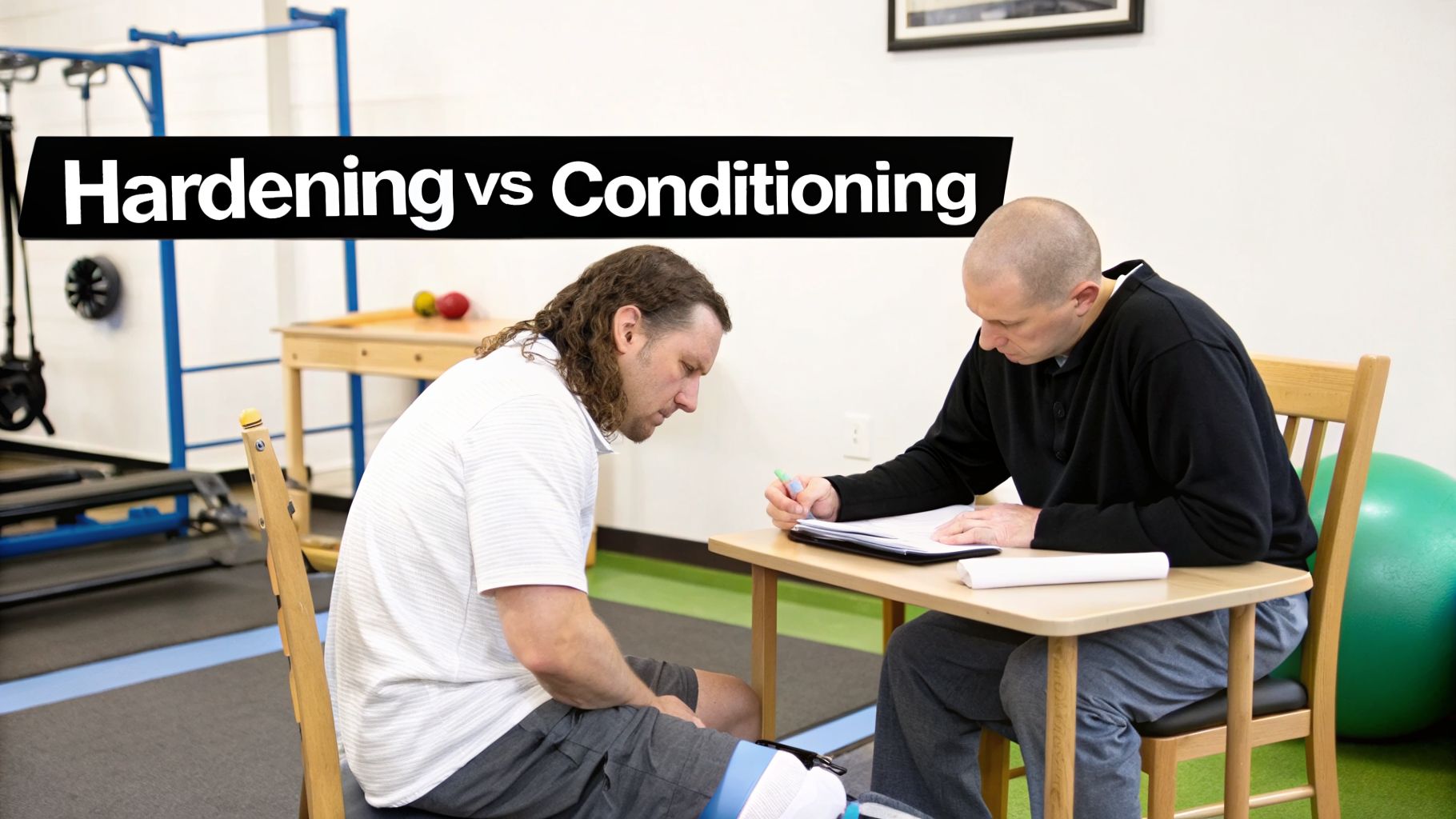
After you've been injured on the job, getting back to full duty isn't always as simple as finishing physical therapy. Many workers get stuck in a frustrating middle ground—they're medically stable, but they just aren't physically ready for the real-world demands of their job.
This is exactly where specialized return-to-work programs come in.
Two of the most common, work hardening and work conditioning, are often mixed up but they serve very different needs. Getting the distinction right is crucial for workers, employers, and case managers to pick the most direct and effective path to recovery.
Comparing the Core Philosophies
Think of work conditioning as a highly focused fitness program. It’s perfect for someone who is motivated to get back to their job but is missing the specific physical tools—like the strength, endurance, or flexibility—to do it safely. It's the final bridge between basic therapy and being job-ready.
In contrast, work hardening takes a much broader, all-encompassing view. This is an intensive, goal-oriented program for workers who are facing more significant hurdles. These problems might go beyond physical deconditioning and include things like a fear of getting hurt again, chronic pain issues, or a real loss of confidence.
Key Takeaway: Work conditioning rebuilds the body for the job. Work hardening rebuilds the whole person for their role, tackling physical capacity, confidence, and coping skills all at once.
Deciding between them always comes down to a full evaluation of the worker’s needs. One program addresses the physical "can't do," while the other tackles the physical, functional, and psychological reasons behind why someone isn't ready.
To make it simple, this table breaks down the main differences at a glance.
Quick Comparison Work Conditioning vs Work Hardening
| Attribute | Work Conditioning | Work Hardening |
|---|---|---|
| Primary Goal | Restore physical capacity (strength, endurance, mobility) for a specific job. | Restore physical, functional, and behavioral readiness for work. |
| Approach | Single-discipline, focused on physical exercise and job simulation. | Multidisciplinary, incorporating physical, occupational, and vocational therapy. |
| Patient Profile | Physically deconditioned but psychologically ready and motivated to work. | Has physical limitations plus psychosocial or behavioral barriers to recovery. |
| Session Duration | Shorter sessions, typically 2-4 hours per day, 3-5 days per week. | Longer sessions that mimic a workday, up to 8 hours per day, 5 days per week. |
| Interventions | Strength training, cardio, flexibility, and functional job tasks. | Real/simulated work tasks, pain management, and behavioral coaching. |
Ultimately, both programs have the same end goal: getting you back to work safely and confidently. The path you take just depends on what obstacles are in your way.
Exploring the Role of Work Conditioning
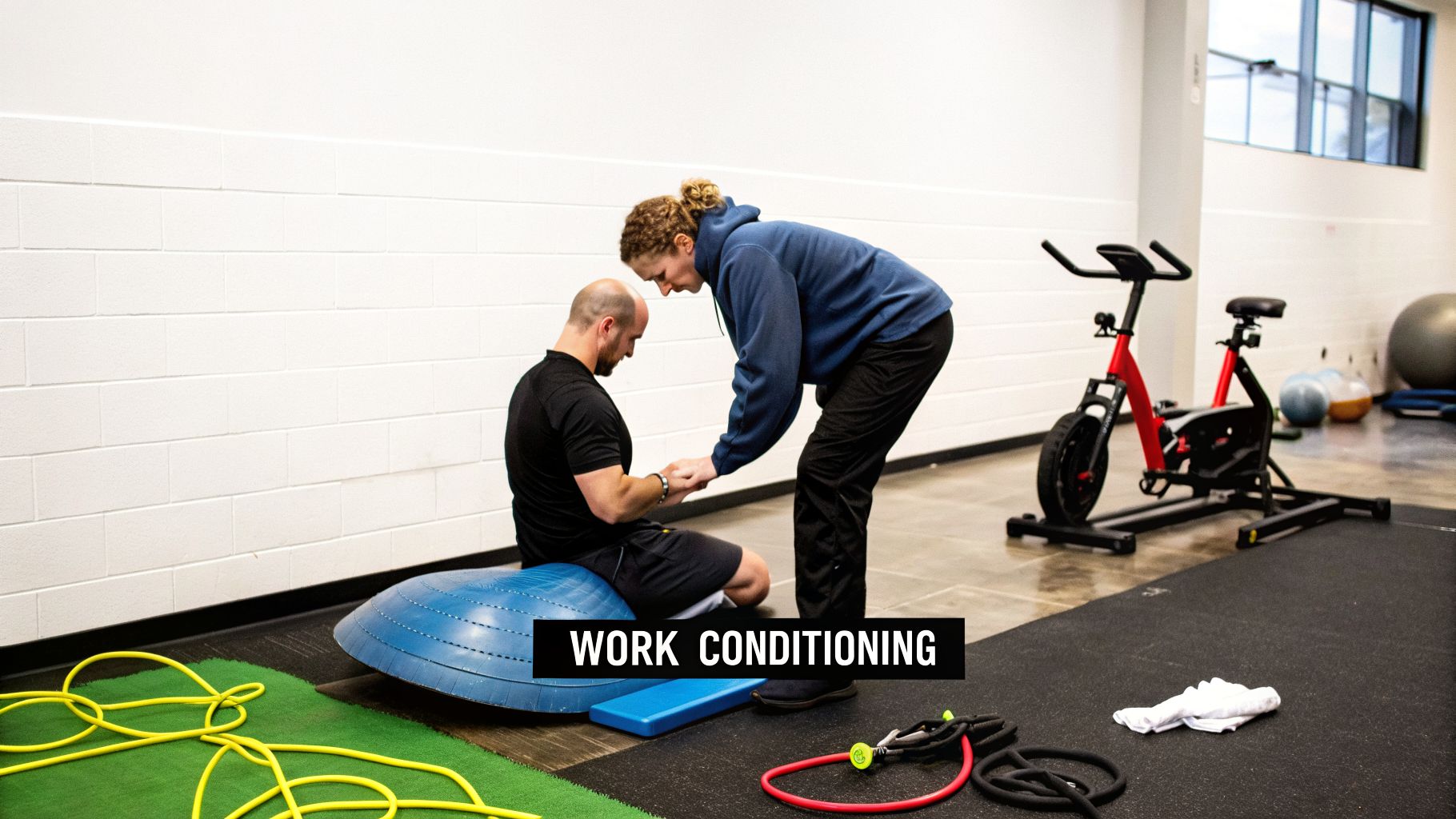
When an injured worker is medically stable but just not strong enough to handle their job’s physical demands, a work conditioning program offers a direct, goal-oriented path forward. Think of it as the crucial bridge between initial recovery and being ready for the job site. This program is built for the motivated worker who is ready to return but simply lacks the physical capacity to do it safely.
The entire point of work conditioning is to systematically restore an individual's strength, mobility, power, endurance, and overall cardiovascular fitness. Unlike general physical therapy, every single activity is directly tied to the specific physical requirements of their job. It's a highly structured and individualized fitness program with one clear goal: getting back to work.
Program Structure and Intensity
Work conditioning is an intensive process designed to get real, measurable results. The schedule is far more demanding than typical outpatient therapy because the goal is to push toward full functional recovery.
A standard work conditioning program usually involves:
- Duration: Sessions typically last between 2 to 4 hours per day.
- Frequency: Appointments are scheduled 3 to 5 days per week.
- Timeline: The total program length can range from a few weeks to a couple of months, depending on where the individual starts and how they progress.
This structure is designed to progressively acclimate the body to a level of physical stress that mimics a partial or even full workday, steadily building tolerance and stamina.
Targeted Physical Interventions
The "conditioning" part is quite literal, involving a series of targeted exercises and functional tasks. A therapist designs a custom plan after a thorough job analysis and an initial assessment of the worker's current abilities.
Interventions are focused and functional, often including:
- Progressive Resistance Exercises: Building the specific muscle strength needed for lifting, carrying, pushing, and pulling on the job.
- Cardiovascular Conditioning: Using equipment like treadmills or stationary bikes to improve the endurance needed for jobs that require sustained activity all day.
- Functional Movement Training: Practicing the exact motions required for the job—like squatting, reaching, climbing, or twisting—to ensure proper and safe body mechanics.
This focused approach ensures that the strength and stamina gained in the clinic directly translate to better performance on the job site, which is key for reducing the risk of re-injury. You can see how our expert therapists design these custom plans in our guide to occupational therapy.
A key differentiator of work conditioning is its singular focus on the physical. The program assumes there are no significant behavioral or psychological barriers, such as fear-avoidance or chronic pain syndrome, that would prevent a successful return to work once physical capacity is restored.
A Real-World Scenario
Imagine a warehouse employee recovering from a lower back strain. Their sharp, acute pain has subsided after their initial therapy, but they still can't safely lift the required 50-pound boxes for an 8-hour shift. They are eager and ready to get back, but they lack the core strength and endurance to do it safely.
Their work conditioning program would include:
- Warm-ups and Flexibility: Preparing muscles and joints for the work ahead.
- Core Strengthening: Exercises like planks and bird-dogs to stabilize the spine for lifting.
- Lifting Simulation: Starting with light weights and perfect form, then gradually increasing to the 50-pound target.
- Endurance Circuits: Combining lifting with walking or carrying tasks to simulate the real pace of a workday.
The data strongly supports this approach. A 2015 analysis by Paragon Safety Group found that 43% of injured workers successfully returned to their regular jobs after completing a work conditioning program. But here's the critical part: timing is everything. Workers who made a full recovery were referred to the program an average of 157 days post-injury, while those who did not were referred after 376 days. The difference is massive, and it shows why starting a conditioning program at the right time is so important for recovery outcomes.
Understanding the Work Hardening Program
While work conditioning focuses on rebuilding physical strength, a work hardening program goes much, much further. Think of it as a full-scale, structured plan that uses real or simulated work tasks to tackle the physical, functional, and even the behavioral challenges that can keep someone from returning to their job.
This is the most comprehensive return-to-work program we offer. It's designed for people who are facing more than just simple deconditioning after an injury. We use an interdisciplinary approach that treats the whole person, which is essential when an injury has led to other issues like chronic pain, a fear of movement, or a loss of confidence.
It Takes a Team
The biggest difference between work hardening and work conditioning is the team and the scope of care. A work hardening program brings together a team of specialists to create a truly integrated recovery plan.
This team often includes:
- Physical Therapists: To guide exercises and ensure every movement is safe and effective.
- Occupational Therapists: To lead job simulation tasks and teach better ways to perform daily functions.
- Psychologists or Counselors: To offer behavioral coaching and help you overcome any mental roadblocks to recovery.
- Vocational Experts: To help with job modifications or even career transitions if necessary.
This team-based strategy makes sure every single aspect of a worker’s readiness is addressed. We’re not just rebuilding the body; we’re rebuilding the mindset and work habits needed for long-term success on the job.
Replicating the Workday
A work hardening program is designed to look and feel like a real work schedule. This prepares both your body and your mind for the demands of a full-time job. The intensity is a major step up from other types of therapy.
Typically, the schedule involves sessions lasting up to a full 8-hour day, 5 days a week. This immersive structure does two things at once: it systematically builds your physical tolerance while also re-establishing the routines of a workday, like managing your time, taking proper breaks, and staying focused.
A work hardening program is essentially a simulated work environment within a therapeutic setting. It's where a person not only regains strength but also re-learns how to be a worker after a long and difficult absence.
More Than Just Exercise
While physical conditioning is definitely a component, the interventions in a work hardening program are designed to dismantle all the barriers holding you back.
Core interventions include:
- Real-time Job Simulation: Using actual tools and materials from your job to perform tasks in a controlled, safe setting.
- Pain Management Education: Learning coping strategies and techniques to manage chronic pain without an over-reliance on medication.
- Behavioral Coaching: Addressing fear-avoidance beliefs, which is when someone avoids certain movements out of fear of getting hurt again.
- Ergonomic Training: Instructing you on proper body mechanics and how to set up your workstation to prevent future injuries.
Research has consistently shown just how powerful this approach is. One analysis of multiple studies found that a work hardening program increased the return-to-work rate by an incredible 52% for patients who had been off work for more than four months. You can explore the full findings from this landmark research in the Journal of Occupational Rehabilitation.
A real-world example shows its power. Imagine a construction worker with chronic back pain and a deep-seated fear of lifting after surgery. His program would involve gradually reintroducing lifting, but it would also include sessions with a psychologist to address his anxiety and pain-related fears. This is exactly the kind of comprehensive care that sets work hardening apart. If you want to understand the full process, you can learn more about what to expect during your first visit at our clinic.
How to Choose the Right Recovery Program
Figuring out the right path back to work after an injury isn't always straightforward. Deciding between a work hardening and a work conditioning program is a clinical call, and it all boils down to what's really holding you back from doing your job safely.
The core question we have to answer is this: are the roadblocks purely physical, or are we dealing with something more complex? If you just need to rebuild strength and stamina, work conditioning is often the direct route. But if a lack of confidence, fear of getting hurt again, or the mental hurdles of chronic pain are part of the picture, we need the more immersive approach of work hardening.
Analyze Your Patient Profile
The right person for each program looks quite different. Getting this part right is the first step toward a recovery plan that actually works.
Someone who’s a great fit for work conditioning is usually:
- Mentally ready and motivated to get back to their job.
- At their point of maximum medical improvement but still has some clear physical gaps.
- Missing the specific strength, endurance, or flexibility their job demands.
- Not struggling with major behavioral issues like fear-avoidance or chronic pain syndrome.
On the other hand, a good candidate for work hardening often:
- Has been out of work for a significant amount of time.
- Shows behavioral barriers, like a visible fear of movement or a real worry about re-injury.
- Has lost the rhythm of a normal workday and finds it hard to pace themselves.
- Needs to regain confidence and functional skills by practicing in a simulated job environment.
This flowchart helps simplify the decision by matching a person's needs to the right program.
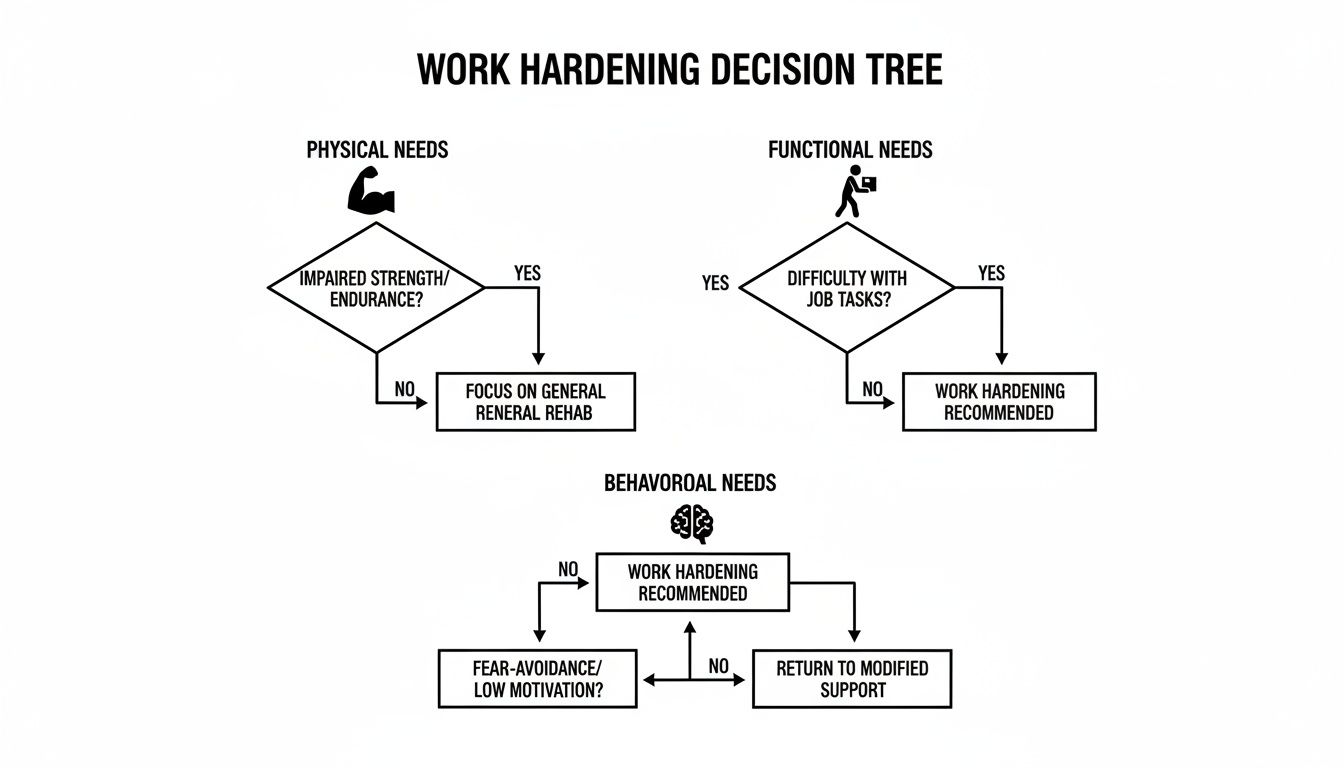
You can see that as soon as behavioral needs come into play, a work hardening program becomes the clear and more effective choice.
Compare Program Goals and Interventions
To get a better feel for the difference, let's look at what you’d actually be doing in each program.
Work conditioning is laser-focused on restoring physical ability. A session might involve progressive lifting, carrying, and cardio exercises designed to get you back to your job's specific physical demands.
Work hardening is about rebuilding the entire worker. It puts you in a real or simulated work environment where you'll tackle multi-hour tasks, learn to manage your energy, and practice pain-coping strategies—all under a therapist's guidance.
A simple way to think about it: Work conditioning rebuilds the body for the job. Work hardening rebuilds the whole person for their role, addressing not just physical capacity but also confidence and work behaviors.
For a detailed side-by-side look, this table breaks down the key differences between the two programs.
Detailed Program Comparison Work Hardening vs Work Conditioning
| Feature | Work Conditioning (Physical Focus) | Work Hardening (Holistic Focus) |
|---|---|---|
| Primary Goal | Restore physical capacity (strength, endurance, flexibility). | Restore functional, physical, and behavioral capacity for work. |
| Target Patient | Physically deconditioned but motivated; no significant behavioral barriers. | Has physical deficits plus behavioral issues (fear-avoidance, confidence loss). |
| Typical Session | 2-4 hours per day, 3-5 days per week. | 4-8 hours per day, 5 days per week (simulating a workday). |
| Interventions | Strength training, cardio, flexibility, job-specific functional exercises. | Real or simulated work tasks, vocational counseling, pain management, behavioral coaching. |
| Environment | Clinical or gym-like setting. | Simulated work environment replicating job demands. |
| Discipline | Single-discipline (usually PT or OT). | Multidisciplinary (PT, OT, Psychologist, Vocational Specialist). |
| Outcome Focus | Meeting specific physical job demands. | Safe, productive, and durable return to full-duty work. |
As the table shows, the choice depends entirely on the scope of the problem. A simple physical gap needs a physical solution, while a more complex, holistic problem requires a holistic program.
Evaluate the Treatment Team and Structure
The team behind your recovery is another key difference. Work conditioning is a single-discipline program, usually run by a physical or occupational therapist who is zeroed in on your physical numbers.
Work hardening, however, is a team sport. It’s a multidisciplinary program that brings together physical and occupational therapists, vocational specialists, and sometimes psychologists. This team collaborates to tackle the interconnected physical and behavioral issues that are keeping you from work.
For providers, it's also important to know the billing nuances, as proper documentation for things like manual therapy billing helps keep these vital programs available.
Ultimately, choosing the right program comes down to a thorough and honest assessment. For injured workers navigating this process, understanding these differences helps you advocate for the right level of care. You can learn more about how we handle these situations by reading about our approach to workers' compensation claims. A detailed evaluation, often including a Functional Capacity Evaluation (FCE), gives us the objective data we need to recommend the program with the highest chance of a safe, lasting, and successful return to your job.
The Future of Advanced Work Rehabilitation
The old lines between work hardening and work conditioning are starting to fade. We're moving away from rigid, separate programs and toward a smarter, more flexible approach that blends the best of both worlds. It's all about creating a faster, more effective path back to work.
This shift comes from a simple reality: a worker’s recovery is rarely a straight line. Someone might start out just needing to rebuild physical strength, but then a fear of getting hurt again pops up. In the old system, that meant stopping everything, getting a new referral, and dealing with delays that just add to the stress.
The Rise of Integrated Programs
Today, the best clinics understand that a rehab plan needs to be able to adapt. Instead of forcing a worker into one box or the other, we now build highly customized programs that change right along with the patient. We call this Advanced Work Rehabilitation.
A patient can now move between different types of therapy without hitting administrative roadblocks. For instance, they might start with a 3-hour session focused on conditioning and endurance. If we notice they're hesitant or showing signs of pain avoidance, we can immediately bring in elements from work hardening, such as:
- Education on how to manage pain flare-ups
- Strategies for pacing their work and energy
- Exercises using graded task simulation to rebuild confidence
This method makes sure the worker is always getting exactly what they need, right when they need it. It smooths out the entire journey from injury back to full duty.
The Role of Functional Capacity Evaluations
The Functional Capacity Evaluation (FCE) is the engine that drives this flexible approach. It's not just a one-time test; it's a tool we use over and over to steer and fine-tune the treatment plan.
An initial FCE gives us an objective starting point, comparing a worker's current abilities to what their job actually demands. We then use follow-up FCEs to measure progress, spot any new issues, and get the hard data we need to adjust the program on the fly. This keeps every single activity focused and purposeful.
The big idea behind Advanced Work Rehabilitation is to stop worrying about strict labels. Instead, we build one holistic plan that can handle both the physical and behavioral hurdles as they appear. This keeps the program moving forward and puts the focus back where it belongs: on the individual's results.
This move toward integrated care isn't just a trend; it's backed by the leading experts in our field. Ever since the American Physical Therapy Association adopted its Occupational Health Physical Therapy Advanced Work Rehabilitation Guidelines back in 2011, the industry has increasingly embraced this combined model. As you can read in the detailed guidelines, this evidence-based approach gives us clear metrics. For example, if we document that a patient can perform 72.6% of their physical job demands at discharge, it’s a clear signal that more advanced rehab is needed to close that final gap. It’s a smarter, more personal way to get injured workers back on the job safely and for good.
Finding Your Recovery Partner in Deerfield Beach
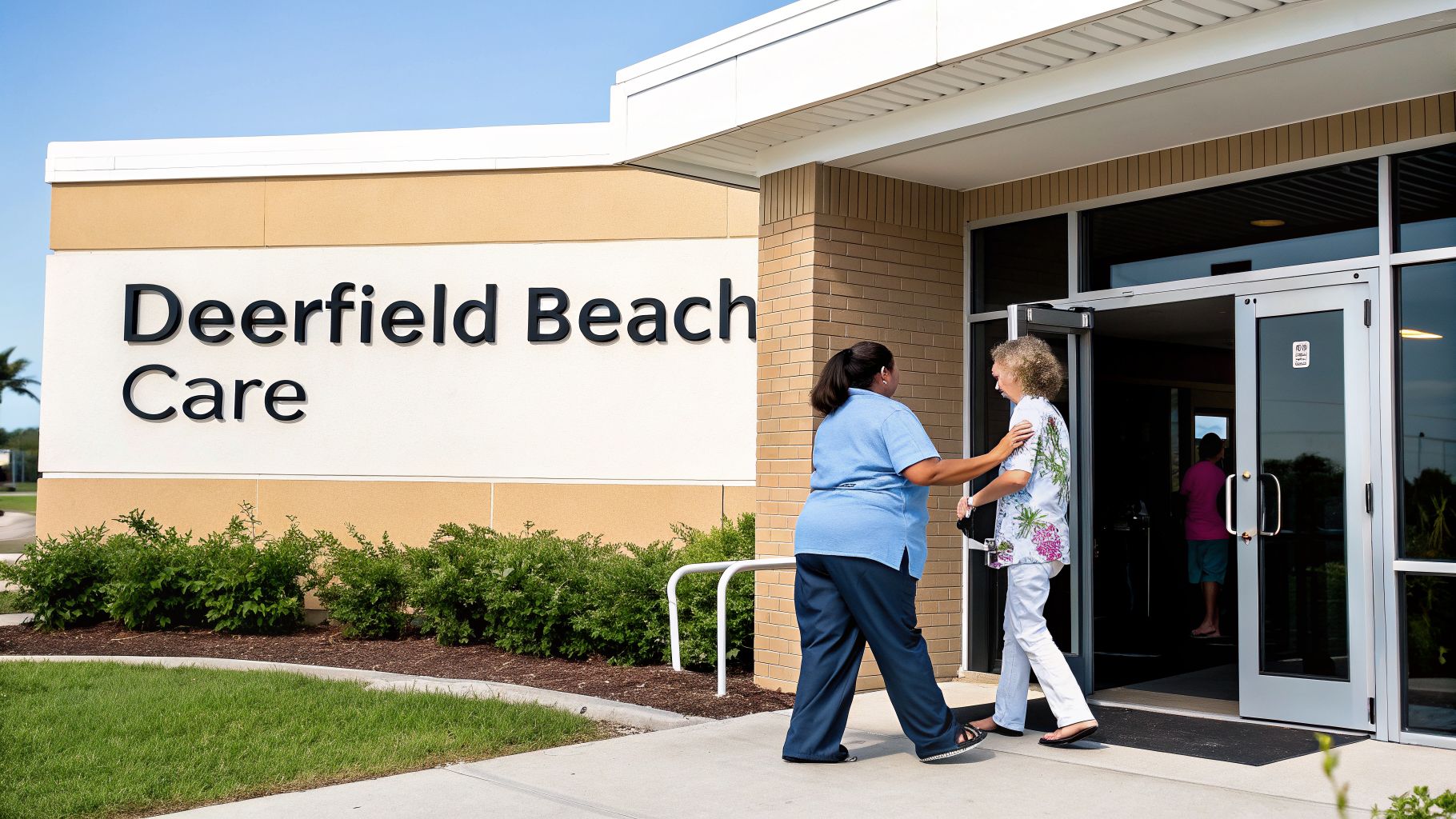
Knowing the difference between work hardening and work conditioning is one thing. Finding the right team to put that plan into action is another. For anyone in Deerfield Beach dealing with a work injury—whether you're the employee, employer, or physician—getting the right program is the key to getting back on the job safely.
We've been part of the Deerfield Beach community at MedAmerica Rehab Center since 1995, focusing on the specific challenges that come with workers’ compensation and auto accident injuries. Experience has taught us that every recovery journey is unique. We often blend the focused drills of work conditioning with the real-world tasks of work hardening to create a plan that fits the person, not just the diagnosis.
A Hands-On Approach to Recovery
Our philosophy is simple: one-on-one, hands-on therapy works best. We don't use a cookie-cutter approach. Our licensed physical therapists and doctors work together to build a program that gets real, measurable results.
Here’s how we do it:
- Integrated Care: We bring together physical therapy, occupational therapy principles, and chiropractic care to look at your recovery from every angle.
- Job-Specific Simulation: We break down your exact job duties and create simulated tasks in the clinic. This helps you safely rebuild the strength and stamina you need for your specific role.
- Clear Communication: We keep everyone in the loop. Constant contact with case managers, employers, and physicians means the process is smooth and transparent for you.
This commitment means your program is built for you, whether you need the targeted physical prep of work conditioning or the comprehensive, job-ready training of work hardening.
At MedAmerica Rehab, we focus on rebuilding more than just strength; we work to restore your movement, your confidence, and your ability to get back to the job you love without fear of re-injury.
Your Local Experts in Workers' Compensation
Navigating a workers’ comp claim can be stressful. You don’t have to handle it alone. Our staff has decades of experience managing the paperwork and communication for these cases, so you can put all your energy into getting better.
We aim to be more than just a clinic—we're your partners in recovery. If you're an injured worker, an employer looking for a reliable provider, or a physician in the Deerfield Beach area, we invite you to talk with our team. Let us show you how our experienced, compassionate approach can make all the difference in a safe and lasting return to work.
Frequently Asked Questions
When you're recovering from a workplace injury, you're bound to have questions. It's completely normal. Understanding the practical side of recovery, like insurance and program selection, is just as important as the therapy itself. Here are some straightforward answers to the questions we hear most often.
Is Work Hardening or Work Conditioning Covered by Insurance?
Yes, in most cases, both work hardening and work conditioning are covered under workers' compensation insurance. The main requirement is that the program is deemed medically necessary to help you get back to your job.
Before you can start, we almost always need to get authorization from the insurance carrier. Our team is very experienced with this part of the process. We work directly with case managers to get your care approved, so all you have to worry about is your recovery.
How Do I Know Which Program Is Right for Me?
Choosing the right program isn't a guess—it’s a decision we make together based on clear, objective information. This comes from a detailed evaluation by one of our therapists, which often includes a Functional Capacity Evaluation (FCE). This test carefully measures your current physical abilities and compares them to what your job actually requires.
The results point us in the right direction:
- If your challenges are purely physical, like a loss of strength or stamina, work conditioning is usually the recommended path.
- However, if you're also dealing with other barriers—like a fear of getting hurt again, struggles with chronic pain, or a loss of confidence—the comprehensive support of a work hardening program is a much better fit.
An FCE is the tool that removes the guesswork. It gives us the hard data needed to recommend the program that offers you the best shot at a safe, successful, and lasting return to work.
What Happens If I Can't Return to My Old Job?
Sometimes, even after putting in all the work, a person might not be able to meet the physical demands of their original job. If this happens, the program was not a failure—in fact, it has provided incredibly valuable information for what comes next.
The detailed notes from your sessions give us objective data on your exact abilities and limitations. This information is vital for your doctor, case manager, and employer. It helps everyone determine the next best steps, which might include vocational counseling, finding ways to permanently modify your old job, or even moving into a new role that’s a perfect match for the skills and strengths you've proven you have.
Ready to take the next step in your recovery with a team that truly understands the road back to work? The experts at MedAmerica Rehab Center have been helping the Deerfield Beach community return to their jobs safely and confidently since 1995. Schedule your consultation today by visiting our MedAmerica Rehab Center website.