
Physical Therapy After Knee Surgery A Recovery Playbook
Coming home after knee surgery can feel overwhelming. The surgery itself is a big step, but your commitment to physical therapy is what truly gets you back to living your life. A structured plan is your best friend here—it breaks down what feels like a mountain into small, achievable hills to climb.
Your Post-Surgery Recovery Roadmap
Think of your recovery as a journey with a clear map. You wouldn't start a road trip without one, and you shouldn't start rehab without a plan. Successful physical therapy after knee surgery is all about following a structured roadmap that methodically rebuilds your strength and mobility. Since 1995, our patient-first philosophy at MedAmerica Rehab has been to create a plan that fits your life and your goals.
This journey is broken into a few key phases. It starts with simple goals like managing swelling and getting your knee straight, and it progresses all the way to getting you back to the activities you love.
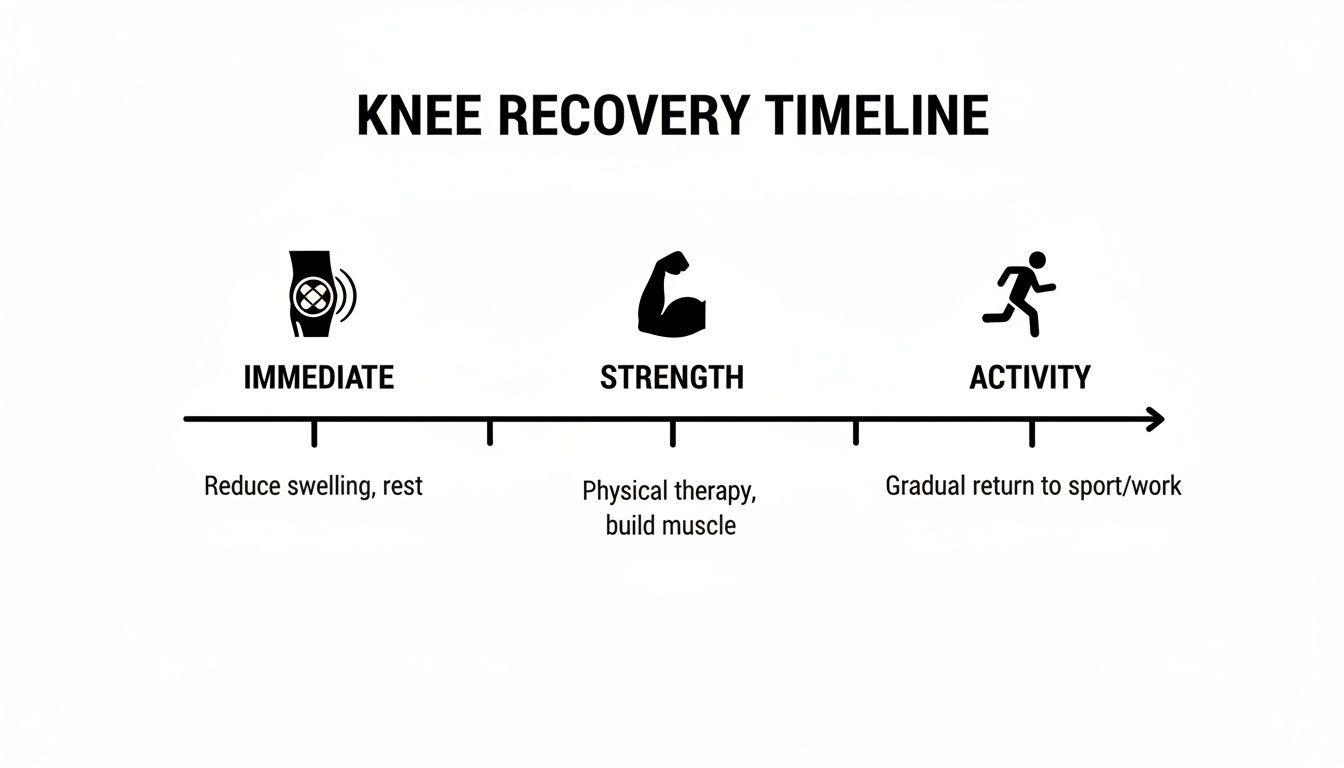
This chart shows how each phase builds on the last. It’s a marathon, not a sprint, and we’re here to guide you every step of the way.
Why A Structured Plan Matters So Much
Following a proven protocol isn't just a suggestion—it's directly linked to better, faster results. In fact, a massive study of over 12,000 patients found that supervised physical therapy using a standardized plan led to far better improvements in motion, strength, and daily function. It just works.
A successful recovery is a partnership. It combines your commitment to doing the work with our expert guidance. That's the formula for getting you back on your feet and living without limitations.
Preparing For A Smooth Recovery
A little prep work before you even start rehab can make a huge difference. Getting your home set up with the right durable medical equipment is a game-changer for safety and comfort. Simple things like a shower chair, a walker, or raised toilet seat can help you stay safe and independent in those first few weeks.
Phases of Knee Surgery Recovery: A Quick Glance
To give you a clearer picture, this table breaks down the typical recovery timeline. It’s a great way to visualize your journey and understand the goals for each stage.
Keep in mind, everyone’s recovery is a bit different, but this gives you a solid framework. You can also get a more detailed look at the timeline in our guide on how long it takes to recover from a total knee replacement.
| Recovery Phase | Typical Timeline | Primary Goals |
|---|---|---|
| Immediate Post-Op | Weeks 1-2 | Manage pain and swelling, get the knee fully straight (full extension), start gentle motion, and wake up the quad muscles. |
| Early Strengthening | Weeks 3-6 | Wean off crutches or a walker, improve knee bend to 90° or more, build foundational strength, and normalize your walking pattern. |
| Functional Strength | Weeks 7-12 | Increase knee bend to 110° or more, begin advanced strengthening, and improve balance and endurance for daily tasks. |
| Return to Activity | Month 3+ | Progress to sport-specific drills, build power and agility, and get cleared to safely return to all your favorite activities. |
This phased approach ensures you build a strong, stable foundation before moving on to more demanding activities, which is the key to preventing setbacks and achieving a full recovery.
The First Weeks: Mastering Pain and Early Movement
Once you’re home from surgery, the real work begins. Those first couple of weeks are all about two things: getting pain and swelling under control, and reintroducing very gentle, specific movements to the knee.
Think of it like this: surgery is a major disruption. Our first job is to calm everything down so we can start rebuilding.
Taming Pain and Swelling
Swelling is your body's normal reaction to surgery, but too much of it is your enemy. It causes pain and, more importantly, it can make the big muscle on the front of your thigh—your quadriceps—completely shut down. When that happens, it’s almost impossible to get your strength back.
Here's your game plan. It’s simple, but you have to be consistent.
- Elevation is Key: Propping your foot on a stool won’t cut it. You need to get your foot above your heart. Lie down and use a wedge or a big stack of pillows under your ankle. Let gravity do the work and drain that fluid away from your knee.
- Consistent Icing: You should be icing for 15-20 minutes almost every hour you’re awake. This is especially important right after you do your exercises. A gel pack that wraps around the whole joint works much better than a bag of frozen peas. We've got more tips on how to use an ice pack in physical therapy the right way.
- Stay Ahead of the Pain: Don't be a hero. It's much easier to keep pain at a low level than it is to bring it down from a high one. Take your pain medication on the schedule your surgeon gave you, instead of waiting until you can't stand it. This makes doing your exercises so much more manageable.
We see this all the time: people put a pillow directly under their bent knee because it feels comfortable. This is a huge mistake. It encourages the joint to get stiff in a bent position, which makes straightening your leg fully later on incredibly difficult. Always prop your ankle up, letting your knee hang straight.
Your First Essential Movements
Rest is crucial, but so is movement. These first exercises might feel basic, but they are non-negotiable. They kickstart muscle activation and, just as importantly, help prevent serious complications like blood clots.
1. Ankle Pumps
This is probably the most important thing you can do while you're resting. Simply point your toes away from you, then pull them back toward your nose. Do this 20-30 times every hour. This little movement gets your calf muscle pumping, which is critical for blood circulation.
2. Quad Sets
This is how we start waking up that sleepy quad muscle.
- Lie down with your leg straight out. You can put a small rolled towel under your ankle.
- Now, try to tighten the muscle on top of your thigh. Think about pushing the back of your knee down into the bed.
- You should feel the muscle get hard and see your kneecap pull up a bit. Hold that for 5-10 seconds, then relax. Do this 10 times.
3. Heel Slides
This is your first move to get your bend back. While lying on your back, just slide your heel up toward your bottom, letting the knee bend as far as it comfortably can. Don't push into sharp pain. Hold for a moment, then slide it back down. The goal here is smooth, easy motion.
Navigating Your Home Safely
You’ll be using a walker or crutches, and using them correctly is key to protecting your knee. At MedAmerica Rehab, we drill this into our patients: "up with the good, down with the bad" when it comes to stairs.
- Going Up: Lead with your good, non-surgical leg. Step up, then bring your crutches and surgical leg up to meet it.
- Going Down: Your crutches and surgical leg go down to the next step first. Then, bring your good leg down.
This simple technique makes sure your strong leg is always doing the hard work, giving you a stable base and keeping your new joint safe. Nailing these first couple of weeks sets the stage for a much smoother recovery ahead.
Building Functional Strength in Weeks 4 to 12
This is where all your hard work in physical therapy after knee surgery really starts to click. The initial, intense post-op period is behind you, and the focus now shifts from just managing pain to actively rebuilding real-world strength. You’re about to start feeling much more like yourself again.
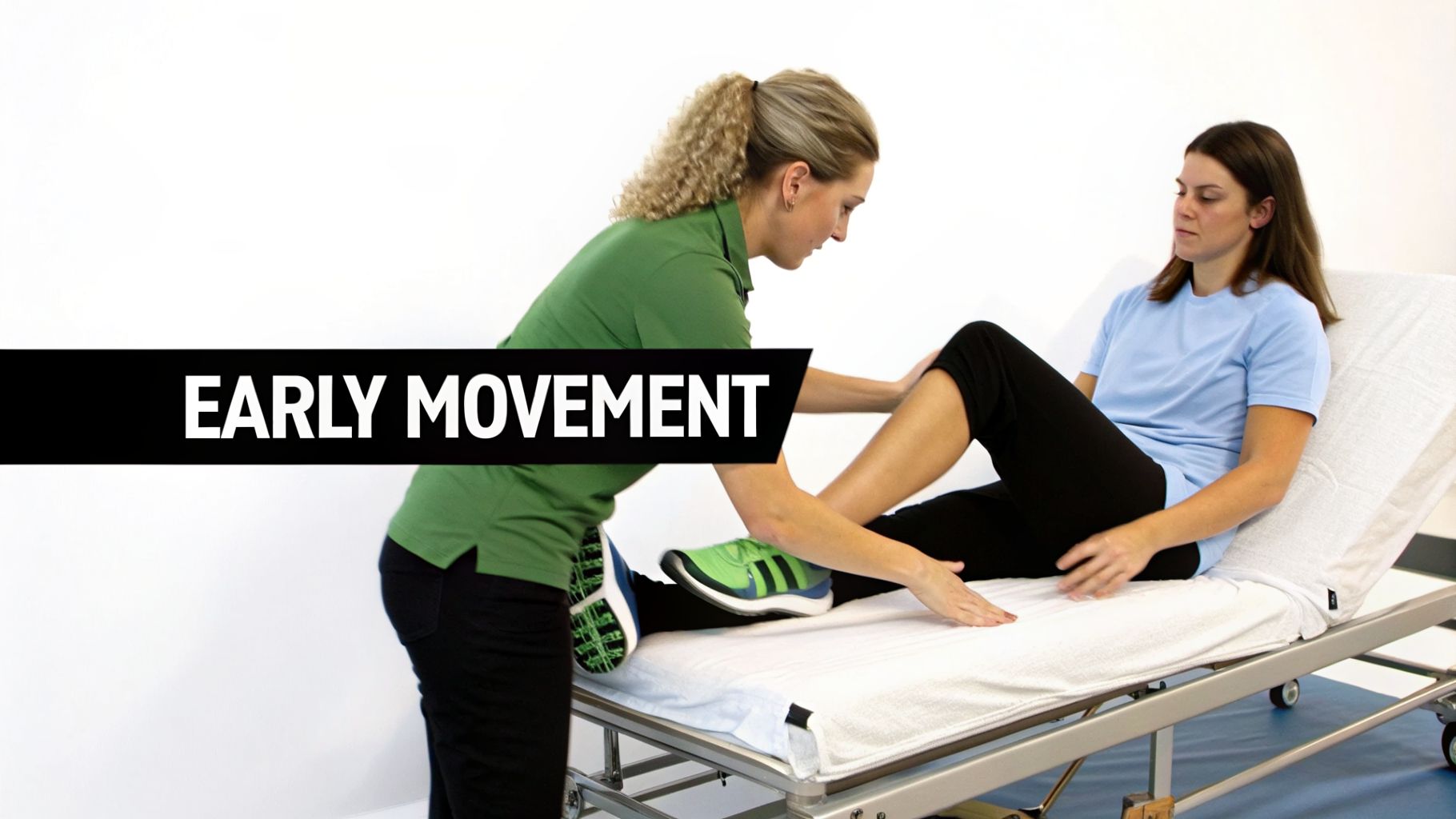
During these crucial weeks, we’ll move beyond gentle movements and begin incorporating more challenging exercises. This isn't just about building muscle; it’s about building functional power—the kind you need to climb stairs without thinking, pop up from a low couch, or walk with a smooth, confident gait.
Key Milestones for This Phase
We’ll keep a close eye on a few key milestones. These aren't just random benchmarks; they are direct indicators that your new knee is integrating properly and your muscles are learning to fire on command again.
Your main goals during weeks 4 to 12 will be:
- Ditching the Crutches: Walking confidently without a walker or crutches.
- Unlocking Your Bend: Achieving 90-110 degrees of knee flexion (bending). This range is what you need for everyday activities like cycling or getting up from a chair with ease.
- Normalizing Your Gait: Walking without a limp or hesitation.
- Building Your Stamina: Standing and walking for longer periods without your knee getting overly sore or tired.
Consistency is everything right now. Research shows that patients who attend around 16-18 physical therapy sessions in the first six weeks see the best results. One study found that 85.1% of patients who stuck to this plan reached at least 100° of active knee flexion, with many hitting the vital 110° mark by week 4.
Exercises to Build Functional Strength
It’s time to level up your exercise program. Your therapist will introduce movements that challenge your strength and coordination, and the focus will be entirely on proper form. Doing an exercise the wrong way can place stress on your new joint and set you back.
Here are a few staples you’ll likely see:
Mini-Squats
This is a core movement for rebuilding your quad and glute strength, which support the knee.
- Stand with your feet shoulder-width apart, holding onto a counter or chair for balance.
- Slowly bend your knees and lower your hips just a few inches, like you’re about to sit down.
- Keep your chest lifted and your weight back in your heels. Make sure your knee tracks straight over your foot, not inward.
- Pause for a second, then squeeze your glutes as you push back up to the starting position.
Stationary Cycling
The bike is your best friend for improving knee bend and endurance without impact.
- Start with zero resistance. The goal is just to make smooth, full circles with the pedals.
- Set the seat height so your leg is nearly straight at the bottom of the pedal stroke.
- As your strength improves, you can gradually add a bit of resistance.
Standing Leg Raises
These are critical for building hip and core stability, which directly translates to a more balanced and powerful walk.
- Forward Leg Raise: Holding onto a stable surface, lift your surgical leg straight out in front of you. Don't bend your knee.
- Side Leg Raise: Lift your leg straight out to your side, keeping your body upright and avoiding any leaning.
For more ideas, you can explore our guide on 5 exercises you can do to strengthen your knees.
Real-World Tip: When you're on the stationary bike, try pedaling backward for a few minutes. This simple switch works your muscles from a different angle and is a fantastic way to nudge your range of motion forward. It's a favorite trick we use at MedAmerica Rehab to break through plateaus.
The Art of Gait Training
One of the most overlooked but critical parts of rehab during this stage is gait training. This isn't just "learning to walk." It’s about reteaching your brain and body to walk correctly. It's incredibly common to develop a limp or other odd walking patterns to guard the knee after surgery.
If we don't fix those patterns now, they become hardwired habits that can cause problems in your back, hip, or even the other ankle down the road.
At MedAmerica Rehab, your therapist essentially becomes a detective, analyzing every part of your stride. We watch for subtle things like:
- How your heel makes contact with the ground.
- Whether you’re fully straightening your knee with each step.
- If you’re spending equal time standing on each leg.
Using verbal cues, mirrors for instant feedback, and hands-on guidance, we help you iron out these hitches. This one-on-one focus ensures you’re not just walking, but walking with an efficient, symmetrical pattern that sets the stage for a full, active life.
Getting Back to an Active Life and Sports
For most people, the real goal after knee surgery isn’t just walking without pain. It’s getting back to the things they love—whether that’s gardening, playing golf, hiking with family, or competing in a sport. This later stage of rehab, usually kicking in around month three to six, is all about making that happen.
We shift from restoring basic daily function to building the strength and agility you need to live an active life with confidence.
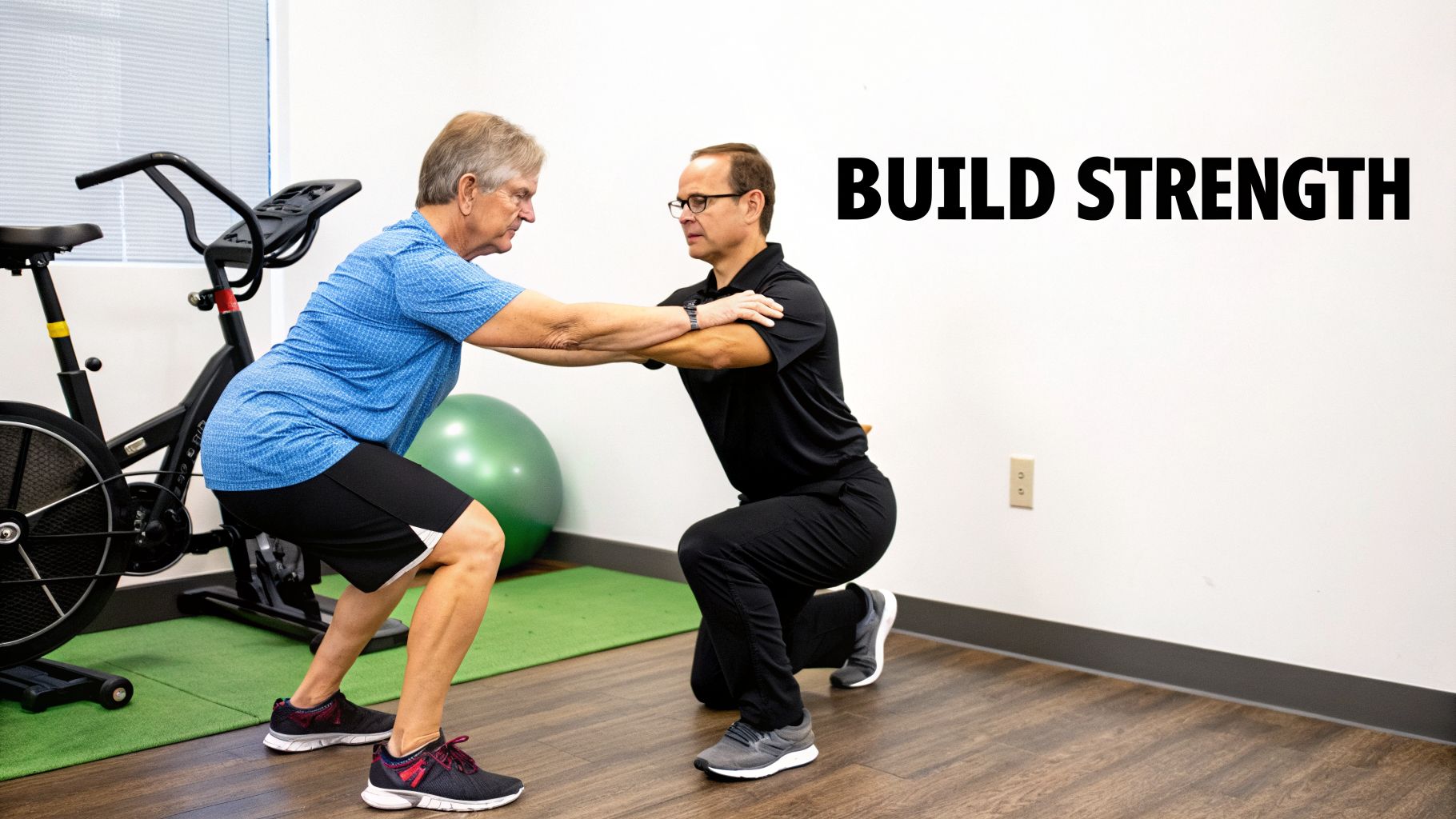
You’ve already put in the hard work to get this far. Now, we build on that foundation to prepare your knee for the faster, more unpredictable movements of the real world. This is where a truly personalized plan makes all the difference in helping you perform at your best, safely.
Are You Ready to Push Harder?
Before we jump into higher-impact training, we need to see a few "green lights" from your knee. Pushing too hard before the joint is ready is one of the fastest ways to have a setback. We’re looking for specific signs that your knee has the stability and control to handle more stress.
Key markers we look for include:
- Little to No Pain: You should be able to go about your day without significant pain.
- Full (or Almost Full) Motion: You can bend and straighten your knee almost completely without issue.
- Solid Single-Leg Balance: You can comfortably stand on your surgical leg for at least 30 seconds.
- Good Strength: You’re able to do functional movements like squats and lunges with proper form.
And we’re not just guessing. This timeframe is backed by major research. A huge meta-analysis looking at over 19,000 patients confirmed that the 3-6 month post-op window is when people see the biggest jumps in function and pain relief. It’s a pivotal time for getting your life back.
Advanced Training and Sport-Specific Drills
Once you’ve checked all the readiness boxes, we can start adding drills that look and feel like your favorite activities. This isn't a generic program. A golfer’s rehab plan will be completely different from a basketball player’s.
We start with controlled, dynamic movements that challenge your knee from all angles.
- Lateral Shuffles: Simple side-to-side steps between cones build the hip strength needed for lateral cuts and pivots.
- Light Jogging: We’ll start you on a careful "walk-jog" program, often on a treadmill, to slowly reintroduce your body to impact.
- Jumping and Landing: This starts small, with two-footed hops onto a low box, and progresses from there. We put a heavy emphasis on landing softly.
- Agility Ladder: Quick footwork drills help retrain your coordination, speed, and ability to change direction on a dime.
This is one of the most important things we teach in this phase: how to absorb force correctly. We spend a lot of time coaching patients to land softly from a jump by bending at their hips and knees, not with a stiff, locked leg. This skill is your single best defense against re-injury.
Your Step-by-Step Return-to-Sport Plan
Getting back to your sport isn’t like flipping a switch. It's a gradual process. At MedAmerica Rehab, we map out a plan that slowly and methodically reintroduces stress, moving you from basic drills all the way to full, unrestricted play.
A tennis player's plan, for example, might look something like this:
- Shadow Swings: Practicing footwork and strokes without a ball.
- Stationary Hitting: Hitting gentle shots while standing in place.
- Limited Movement: Hitting balls while taking just a few small steps.
- Full-Court Drills: Moving through structured, non-competitive drills.
- Practice Games: Playing short, low-intensity practice sets.
- Full Return: Cleared for competitive, unrestricted matches.
As you get more mobile and confident, especially on uneven ground like a trail or a golf course, certain tools can be a huge help. Using balance walking poles, for instance, can give you extra stability and take some of the load off your knee. This allows you to build endurance safely. Following a smart, phased approach like this is how you get back in the game—and stay there.
What to Expect at Your First PT Appointment
Walking into a physical therapy clinic for the first time after knee surgery can be nerve-wracking. We get it. That’s why your first visit at MedAmerica Rehab is built around a conversation, not an exam. We need to understand your story before we ever touch your knee.
We’ll start by listening. Tell us about your surgery, what your pain feels like, and what daily tasks have become a challenge. Most importantly, what do you want to get back to doing? This chat is the foundation for everything that follows.
The Initial Evaluation Process
Once we understand your goals, your physical therapist will do a thorough but gentle evaluation to see where you’re starting from. We're careful not to cause any unnecessary pain—we’re just gathering information.
Here’s what we’ll look at:
- Pain Levels: Where it hurts, when it hurts, and what the pain feels like.
- Swelling: We’ll take a quick measurement of the fluid around your knee joint.
- Range of Motion: We will gently check how far you can bend and straighten your knee.
- Strength: We’ll test how well key muscles are firing, especially your quad.
- Mobility: We’ll watch you walk and move, with a walker or crutches if you’re using them.
This assessment gives us a clear starting point. It shows us exactly where we need to focus to get you moving safely and feeling better, fast.
Your personal goals drive everything we do. If your main goal is to kneel in your garden or get back on the golf course, that shapes your exercises and milestones differently than if your goal is to walk your dog around the block without pain. This is your recovery, and your goals are the destination.
Creating Your Custom Treatment Plan
Your story and our evaluation come together to form your treatment plan. This isn’t a generic handout we give to everyone. It's a roadmap built specifically for you, right here in our Deerfield Beach clinic.
As a family-owned, multidisciplinary clinic, we can create a truly complete plan. For some, that might mean adding chiropractic care to address any hip or back misalignments that are affecting the knee. For others, we might use shockwave therapy to speed up tissue healing around the joint.
We also keep the logistics simple. We work with most insurance plans and offer convenient same-day appointments so you can start your recovery without waiting. From the moment you walk in, our focus is on creating a partnership to get you the results that have earned us our five-star reviews.
Common Questions About Knee Surgery Rehab
Going into knee surgery, it’s completely normal to have a long list of questions about what comes next. The recovery process can feel like a huge unknown. We get it.
Here, we’ll tackle the most common questions we hear every day from our patients. Our goal is to give you clear, straightforward answers based on years of experience, so you can feel confident about the road ahead.

How Much Pain Is Normal During Physical Therapy
This is probably the biggest question on everyone's mind. You should expect some discomfort as you start moving and building strength again, but it should never feel sharp, shooting, or unbearable.
We have a saying that "motion is lotion" for the joint. A good therapist will push you into a zone that feels challenging but totally manageable. A huge part of our job is helping you learn the difference between the productive soreness of working muscles and the "bad" pain that signals a problem. Your feedback is everything, so always speak up about what you're feeling.
A common complaint after knee replacement is lingering stiffness. This usually comes from scar tissue or not pushing the range of motion enough in the early weeks. Consistent, guided therapy helps prevent this and keeps the joint moving smoothly.
How Long Will My Physical Therapy Actually Take
There’s no one-size-fits-all answer here. Your recovery timeline really depends on the type of surgery you had, your fitness level before the procedure, and what you want to get back to doing.
In general, you can expect a comprehensive rehab plan to last anywhere from three to six months.
The most intense phase is usually the first 6-8 weeks, when we’re focused on getting your basic motion and function back. While you can see huge gains in your range of motion in just 16-18 sessions, continuing with therapy is what builds the long-term strength and stability you need for a full, active life.
When Can I Drive, Work, or Play Sports
These are the big milestones everyone is eager to hit. The timelines are very individual and you always need the green light from your surgeon and therapist, but here are some general guidelines:
- Driving: You can usually get back behind the wheel once you’re completely off narcotic pain medication and can slam on the brake without hesitation. For a right knee surgery, this is often around 4-6 weeks. If you had surgery on your left knee and drive an automatic, it might be sooner.
- Returning to Work: A desk job may be possible within 4-6 weeks, as long as you have a way to elevate your leg. For a more physical job with lifting or prolonged standing, you’re looking at a much longer timeline—often 3 months or more.
- Returning to Sports: This is the final frontier. You might start low-impact activities like swimming or using a stationary bike around the 2-month mark. Getting back to high-impact sports like running, tennis, or basketball is a longer-term goal, often taking 6-12 months to do safely.
What Are the Warning Signs to Watch For
Knowing what’s normal versus what’s a red flag is critical for a safe recovery. While some soreness is part of the deal, you need to call your doctor or therapist right away if you notice any of these symptoms:
- A sudden spike in pain, swelling, or redness that doesn’t improve with ice and elevation.
- Any drainage, pus, or a bad smell coming from your incision.
- A fever or chills, which could signal an infection.
- Serious, focused pain, swelling, and tenderness in your calf. This could be a deep vein thrombosis (DVT), or blood clot, which is a medical emergency.
Trust your gut. If something just doesn't feel right, it’s always better to make the call and get it checked out.
At MedAmerica Rehab Center, we’re here to partner with you through every single step of your recovery. If you're getting ready for knee surgery or need guidance on your rehab, schedule your first appointment by visiting https://www.medamericarehab.com.