
How to Relieve Lower Back Pain Naturally with Proven Methods
Dealing with lower back pain means you need a game plan. The best approach combines smart, immediate care—like gentle movement and using heat or ice—with targeted exercises to build strength and flexibility. Over the long haul, simple habits around your posture and sleep create a solid foundation to keep the pain from coming back.
Understanding Why Your Lower Back Hurts
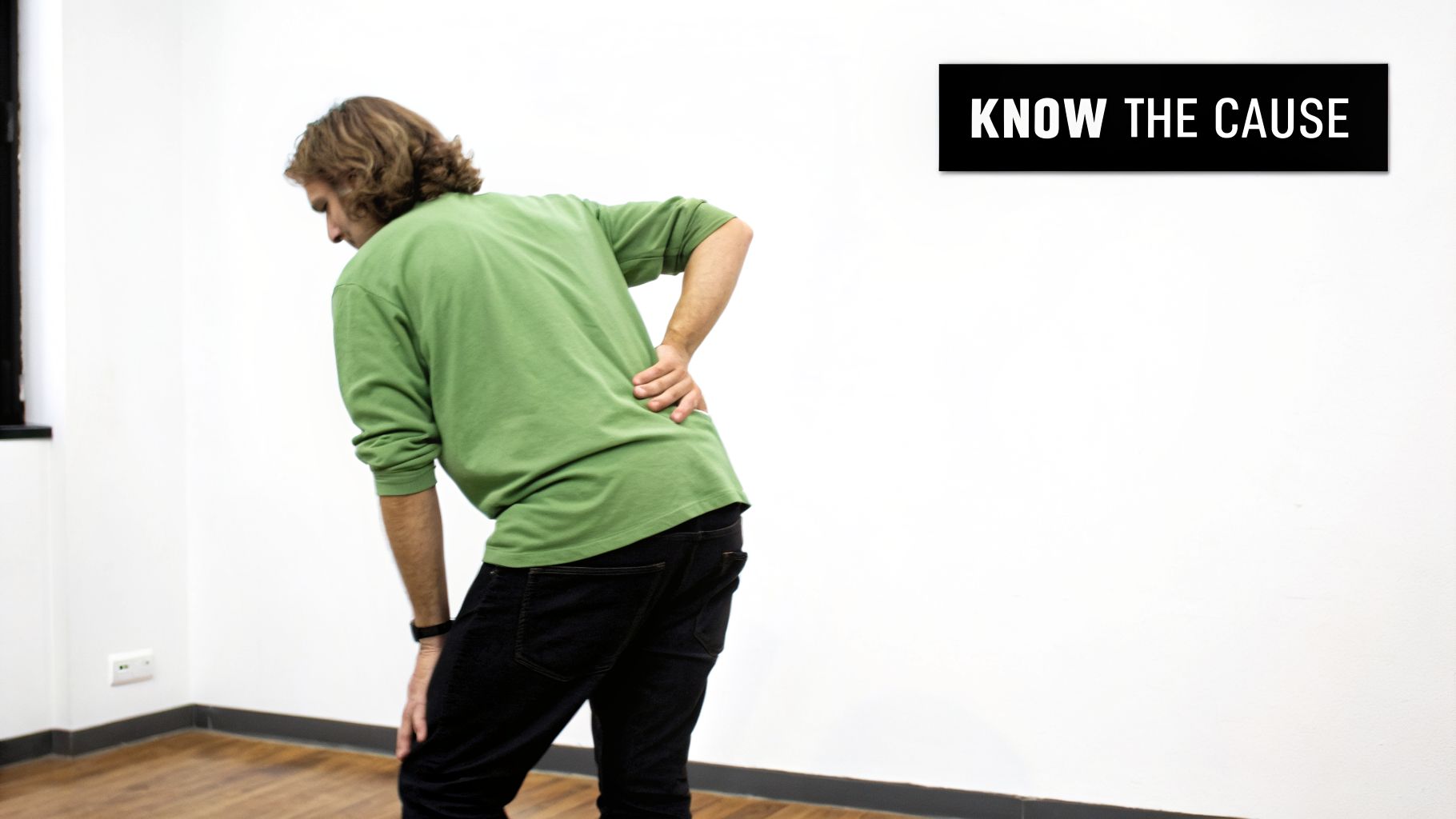
Before you can start feeling better, you have to figure out what's going on. That sharp twinge or dull, constant ache is your body’s way of telling you something isn't right. Getting to the "why" behind your pain is the first real step toward finding relief that lasts.
If your back hurts, you’re in good company. In 2020 alone, an incredible 619 million people around the world dealt with low back pain, and it’s the single biggest cause of disability. Experts predict that number could hit 843 million by 2050.
But here’s the good news: solid evidence shows that the right exercises and hands-on therapies make a huge difference, helping up to 70% of working-age adults get back on their feet. You can explore more data on this global health issue00055-5/fulltext) to see just how effective treatment can be.
Acute Pain Versus Chronic Pain
It’s really important to know what kind of pain you're up against. Did it just start, or has it been hanging around for a while?
- Acute Pain: This is the pain you feel right after you do something specific, like lifting a heavy box the wrong way or twisting awkwardly. It’s short-term and usually lasts anywhere from a few days to a few weeks. Think of it as a muscle strain or ligament sprain.
- Chronic Pain: This is the pain that sticks around for 12 weeks or longer, long after the initial injury should have healed. It’s often more complex and might be tied to an underlying issue like arthritis, disc problems, or ongoing muscle imbalances that never got sorted out.
Knowing which type you have helps you choose the right path. Acute pain often gets better with a bit of rest followed by gentle movement. Chronic pain, on the other hand, usually needs a more structured plan focused on building strength and changing daily habits.
Common Causes Behind the Ache
Your lower back is a busy intersection of bones, joints, ligaments, and muscles. A problem with any one of these parts can set off a pain signal. For most people, the issue is mechanical—it has to do with how your spine moves and handles weight.
Some of the most common culprits include:
- Muscle or Ligament Strain: This is the big one. It's usually caused by lifting something too heavy, a sudden twist, or just overdoing it.
- Poor Posture: Hours spent slouching over a keyboard or behind the wheel puts a ton of stress on your back.
- Sciatica: This is nerve pain that shoots from your lower back down your leg. It happens when the sciatic nerve gets pinched or irritated.
- Herniated or Bulging Discs: The soft, jelly-like cushions between your vertebrae can bulge or rupture, pressing on nearby nerves.
- Underlying Conditions: Sometimes, the pain is a symptom of something else, like arthritis or spinal stenosis (a narrowing of the spinal canal).
When to See a Doctor Immediately
Most of the time, you can manage lower back pain at home. But some symptoms are "red flags" that signal a more serious problem that needs a doctor's attention right away.
Do not ignore symptoms like new or worsening numbness in your groin or legs, a loss of bladder or bowel control, or intense pain accompanied by a fever. These are medical emergencies.
Get professional help right away if you experience any of the following:
- Pain that started after a major trauma, like a car crash or a bad fall.
- Loss of control over your bladder or bowels.
- Weakness, tingling, or numbness in your legs that keeps getting worse.
- Back pain combined with a fever or unexplained weight loss.
Knowing these warning signs is crucial for your safety. For all other types of mechanical back pain, the next sections will give you a clear roadmap to getting relief naturally and taking back your life.
When that first twinge of lower back pain hits, what you do in the first few hours can make all the difference. The old advice was to head straight to bed and stay there, but we now know that’s one of the worst things you can do.
Your game plan should be to calm things down, not shut them down. Acting quickly with the right strategies can soothe irritated tissues, stop your muscles from locking up, and get you on the path to feeling better, faster.
The Smart Use of Heat and Ice
One of the first questions people ask is, "Should I use heat or ice?" The answer really depends on how and when your pain started. These are two simple, powerful tools, but using the right one at the right time is key.
For the first 24 to 48 hours following a new injury or a sudden flare-up, think ice. An ice pack helps constrict blood vessels, which is exactly what you want to reduce swelling, numb the sharp pain, and calm inflammation. It's like calling in the firefighters to put out that initial fire.
Once you’re past that initial 48-hour window, or if you're dealing with chronic muscle soreness that just feels tight and achy, it’s time to switch to heat. A heating pad or a warm compress does the opposite of ice—it boosts blood flow. This brings fresh oxygen and nutrients into the area, helping those stiff, tight muscles finally relax.
To help you decide which is best for your situation, here's a quick comparison.
Using Heat vs Ice for Lower Back Pain
| Therapy Type | Best For | How It Works | When to Use |
|---|---|---|---|
| Ice (Cryotherapy) | Acute pain, new injuries, swelling, and inflammation. | Constricts blood vessels to reduce swelling, inflammation, and numb sharp pain. | The first 24 to 48 hours after an injury or sudden flare-up. |
| Heat (Thermotherapy) | Chronic pain, muscle soreness, stiffness, and achiness. | Increases blood flow, bringing oxygen and nutrients to relax tight muscles. | After the first two days, or for ongoing muscle stiffness without noticeable swelling. |
Regardless of which you choose, always protect your skin. Never place an ice pack or heating pad directly on your back. Wrap it in a thin towel and keep it on for only 15-20 minutes at a time, taking at least an hour-long break between sessions to let your skin recover.
For a deeper dive, you can check out our guide on the proper way to use an ice pack in physical therapy.
The Power of Gentle Movement
I know it sounds backward, but staying completely still can actually make your back pain worse. When you don't move, your muscles get stiff and weak, which just feeds the cycle of pain. The goal isn't to push through sharp pain, but to find small, gentle movements that feel safe.
This encourages blood flow and keeps your back from completely seizing up.
Think small and controlled.
- Knee-to-Chest: Lie on your back and gently pull one knee toward your chest. Hold it for 15-30 seconds, feeling a light stretch, then switch sides.
- Pelvic Tilts: While lying on your back with your knees bent, gently flatten your lower back against the floor. You should feel your core muscles engage. Hold for a few seconds, then relax.
It’s hard to overstate how much these simple steps can help. Non-specific low back pain is incredibly common, affecting 60-70% of people in industrialized nations. But we also know what works. Research shows that applying heat for just 20 minutes twice a day can ease muscle spasms in 75% of cases. When you combine that with gentle movement, the results are even more powerful. You can read more about the global impact of low back pain and effective treatments to understand why getting this first response right is so important.
Core Exercises to Build a Stronger Back
While heat and ice can take the edge off a flare-up, true, long-lasting relief from lower back pain comes from building a stronger, more resilient body. This is where we move from temporary fixes to a permanent solution: creating a stable core and flexible muscles that can handle the demands of your day.
Think of it this way: a weak core often forces your lower back to do a job it was never designed for. Everyday movements—lifting groceries, bending over, or even just sitting at a desk—put extra strain on your spine because the surrounding muscles aren't pulling their weight. Building a strong core is like giving your back a built-in support system.
The goal here isn’t to push through pain. It's about building a solid foundation safely, with control and intention. We'll walk you through the exercises that actually work, focusing on proper form to get you strong without setbacks.
Mastering Foundational Core Stability
Before you jump into more intense exercises, you have to wake up the right muscles. These first few moves are designed to activate the deep core muscles that hug your spine, providing stability from the inside out. The key is to move slowly and deliberately.
Pelvic Tilts
This is a small but mighty movement. It’s fantastic for re-establishing the connection between your brain and your deep abdominal muscles, which helps you control the position of your pelvis and take pressure off your lower back.
- Lie on your back, knees bent and feet flat on the floor about hip-width apart. Let your arms rest by your sides.
- Gently tighten your stomach muscles to press your lower back flat against the floor, feeling your pelvis rock back slightly.
- Hold that gentle squeeze for 5-10 seconds, making sure to breathe normally.
- Relax and let your back return to its natural curve. Aim for about 10 repetitions.
Bird-Dog
I love the bird-dog for building balance and spine stability. It teaches your torso to stay completely still while your arms and legs are moving—a skill that protects your back during almost every daily activity.
- Get on your hands and knees, stacking your wrists directly under your shoulders and your knees under your hips.
- Brace your core to keep your back flat. A great cue is to imagine balancing a glass of water on your lower back.
- Slowly reach your right arm straight out in front of you as you extend your left leg straight back.
- Hold for 3-5 seconds, focusing on keeping your hips and shoulders perfectly level.
- Return to the starting position with control, then switch sides. Try for 8-12 reps on each side.
Pro Tip: The most common mistake is arching the lower back or letting a hip drop. If you feel wobbly, just practice lifting one leg or one arm at a time. You'll build stability faster by doing it right.
Building Strength to Support Your Spine
Once you've got the basics down, you can start building more serious strength in the muscles that act as a primary support crew for your lower back, especially your glutes.
This simple flow is the perfect way to prep your body for strengthening work, especially if you're feeling stiff or sore.
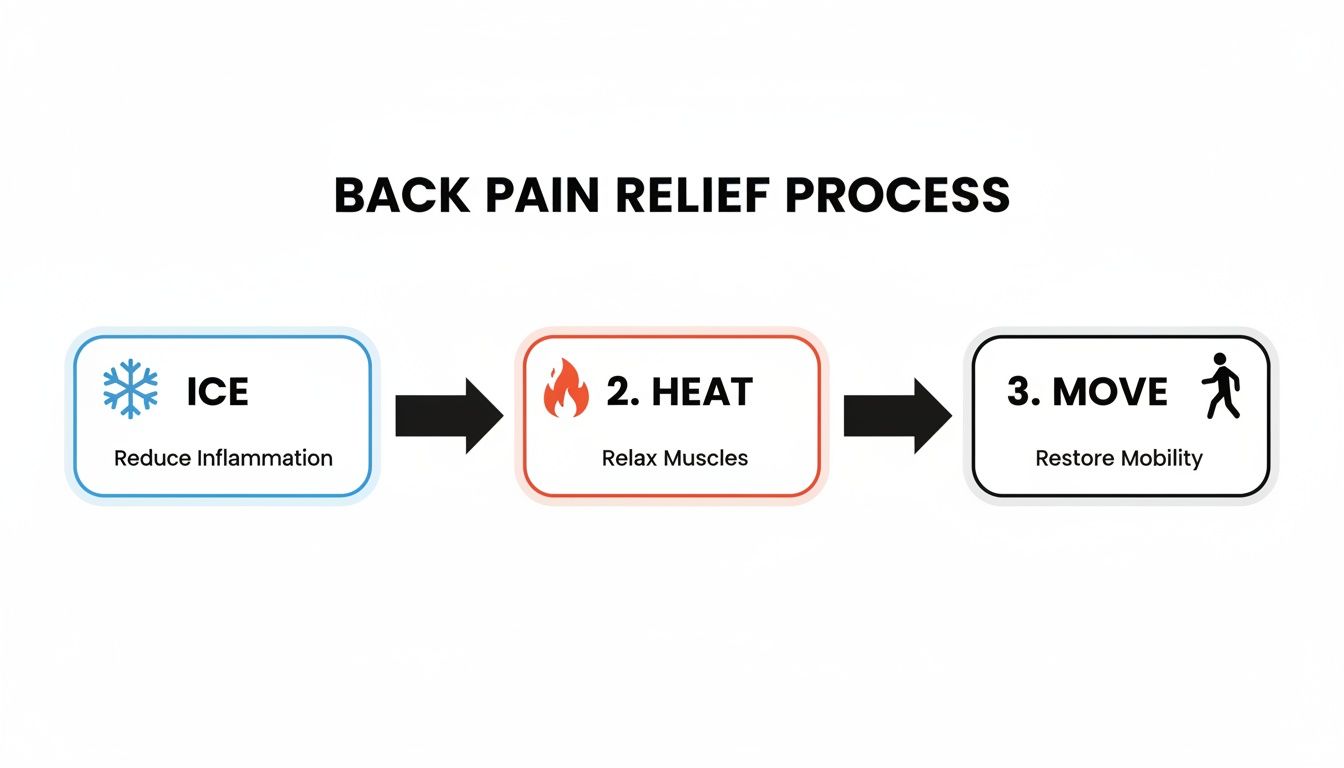
Starting with ice, then moving to heat, and finally introducing gentle movement is a proven sequence. It calms things down so you can safely begin to build strength.
Glute Bridges
Your glutes are some of the most powerful muscles in your body. When they're not firing correctly, your lower back almost always takes on the extra load.
- How to Do It: Lie on your back with your knees bent, feet flat on the floor. Squeeze your glutes to lift your hips up until your body makes a straight line from your shoulders to your knees.
- Form Check: Make sure you aren't arching your back to get higher. The lift should come from a powerful glute squeeze, not from your spine.
- Repetitions: Hold for just a second or two at the top, then slowly lower back down. Go for 12-15 reps.
Building up these key muscles is a cornerstone of effective physical therapy. If you want to explore a more comprehensive routine, you can learn more about how to strengthen your core with these exercises in our in-depth guide.
Releasing Tightness with Essential Stretches
Strength is only one part of the equation. If your muscles are tight, they'll pull on your pelvis and spine, contributing to that familiar ache. Adding these simple stretches can make a world of difference.
Hamstring Stretch
Lie on your back and bend one knee. You can loop a towel or yoga strap around the ball of your other foot. Gently pull that leg toward you, keeping it as straight as you can, until you feel a good stretch down the back of your thigh. Hold for 30 seconds and then switch.
Knee-to-Chest Stretch
Lying on your back, gently pull one knee in toward your chest with both hands. This gives a nice, gentle stretch to the lower back and glute muscles. Hold for a full 30 seconds before repeating on the other side.
For a routine that blends both gentle mobility and strength, exploring some yoga for core strength beginners can be incredibly helpful. Poses like Cat-Cow and Child’s Pose are perfect for mobilizing the spine and easing tension. Remember, consistency is what builds a back that can keep you pain-free for the long haul.
Optimizing Your Daily Habits for a Pain-Free Life
While targeted exercises are a crucial piece of the puzzle, they only account for a small fraction of your day. It's what you do in the other 23 hours that often makes the biggest difference. Your daily habits—the way you sit, stand, lift, and even sleep—can either constantly aggravate your lower back or become a powerful tool for healing.
Think about it: the average person spends between six and nine hours a day sitting, often slumped over a desk or a phone. That posture puts continuous, low-grade stress on your spine. By making a few mindful adjustments to these everyday activities, you can dramatically reduce that strain and create an environment where your back can finally recover.
Creating an Ergonomic Workspace
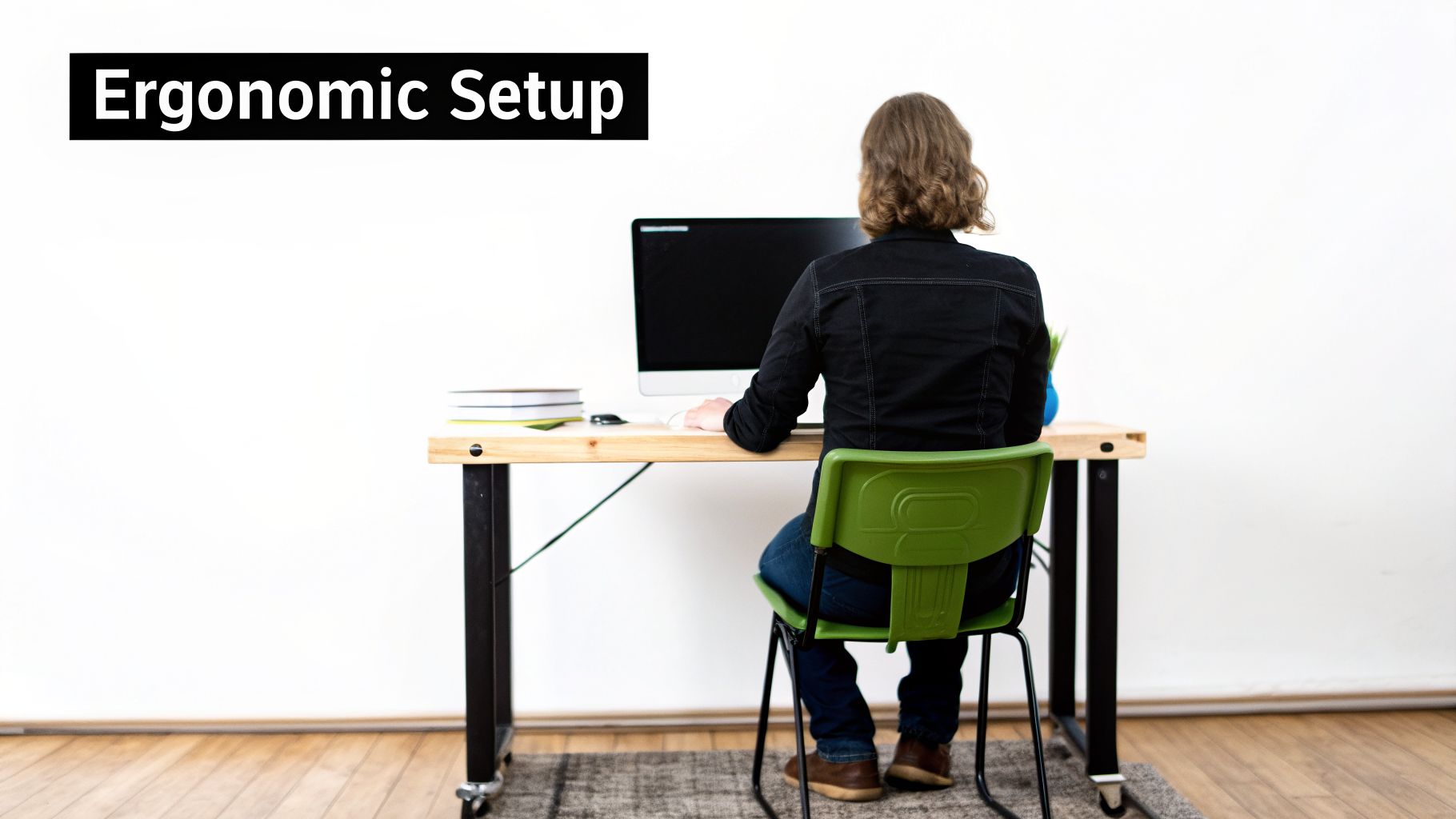
If you work at a desk, your setup is one of the most important places to start. An ergonomic workspace isn't about buying expensive gear; it’s about arranging what you already have to support your body's natural alignment.
The main goal is to maintain a neutral spine, avoiding that all-too-common slouch that pulls on your lower back for hours on end.
- Chair Height: Adjust your chair so your feet can rest flat on the floor, with your knees at or slightly below your hips. This simple change immediately takes some pressure off your lower back.
- Lumbar Support: Your chair should support the natural inward curve of your lower back. If it doesn't have built-in support, just roll up a small towel and place it in the small of your back. This little trick can make a huge difference.
- Monitor Position: The top of your computer screen should be at or just below eye level, about an arm's length away. This keeps you from craning your neck forward, which tugs on your entire spine.
- Keyboard and Mouse: Keep your keyboard and mouse close enough that your elbows can stay comfortably by your sides, bent at a 90-degree angle. Reaching forward all day strains your shoulders and upper back.
Making these adjustments is a game-changer. For even more ideas on how to stay comfortable at your desk, our team put together some helpful tips to reduce back pain throughout your work day.
Remember to get up and move for a few minutes every half hour. Even a quick stretch or a walk to the kitchen can break the cycle of static posture and give your back a much-needed reset.
Smarter Lifting and Better Posture
Back pain rarely comes from one single event. More often, it's the result of thousands of tiny, incorrect movements that add up over months or years. Relearning how to lift and stand properly is one of the most powerful ways to protect yourself.
The golden rule of lifting is simple: bend at your knees and hips, not with your back. When you pick something up, keep the object close to your body and tighten your core. Let your powerful leg muscles do the heavy lifting—think of it as doing a squat, not folding your spine in half.
When you're standing, try to distribute your weight evenly on both feet. Avoid locking your knees and let your shoulders relax. Think "tall and proud," with your head balanced over your shoulders and your shoulders stacked over your hips.
Optimizing Your Sleep for Recovery
Sleep is when your body does most of its repair work. But if your sleeping position puts your spine in an awkward alignment all night, you're robbing yourself of that crucial recovery time. Many people wake up with back pain simply because of how they slept.
The best sleeping positions for back pain are usually on your back or your side.
- If you sleep on your back: Try placing a small pillow under your knees. This helps maintain the natural curve of your lower back and reduces strain.
- If you sleep on your side: Place a pillow between your knees. This helps keep your hips, pelvis, and spine in a straight, neutral line.
A huge part of this is having the right support. It might be time to look into the best mattress for back pain that you can find—one that is firm enough to provide support but has enough give to contour to your body. Your mattress should prevent your spine from sagging into a "hammock" position. These small changes add up, turning your daily routine into a solid foundation for lasting relief.
Time for a Helping Hand? When to See a Professional
Doing the right exercises, fixing your posture, and being smarter about your daily habits are the cornerstones of getting your back pain under control. But what happens when that's not enough?
If the pain just won't quit, gets worse, or starts seriously messing with your life, calling in a professional is the smartest move you can make. This isn’t a sign that your own efforts failed. Think of it as adding an expert to your team.
A lot of people wait, thinking they should be able to handle it alone. But a trained professional can pinpoint the real cause of your pain much more accurately, offer targeted hands-on treatments, and build a recovery plan that's truly meant for you, speeding up the whole process.
Hands-On Therapies That Actually Work
When you feel like you've hit a wall with self-care, a few evidence-based therapies can make a world of difference. These aren't just passive treatments; they're an active partnership between you and a practitioner to get you moving better and feeling better.
- Physical Therapy: Think of a physical therapist as a detective for your body's mechanics. They'll watch how you move, find the specific muscle weaknesses or imbalances causing trouble, and design an exercise program just for you. This is miles beyond generic stretches, focusing on exactly what your body needs to support your spine and stop the pain from coming back.
- Chiropractic Care: A chiropractor zeroes in on the link between your spine’s alignment and how well your nervous system is working. Using gentle, controlled adjustments, they work to get your joints moving correctly again, especially in spinal segments that have become stiff or stuck. This can ease nerve irritation and give you back your range of motion.
- Acupuncture: This ancient practice uses incredibly thin needles placed at specific points on the body. From a modern scientific view, we believe acupuncture helps kickstart the nervous system. It can trigger the release of endorphins—your body’s own natural painkillers—and boost blood flow to calm inflammation and relax those stubbornly tight muscles.
The most important thing to remember is that these therapies work best when they fix the root cause of the pain, not just mask the symptoms. A great practitioner will teach you what’s going on and give you the tools to manage it for good.
Finding the Right Fit for You
So, which therapy should you choose? It often comes down to the type of pain you have and what you feel most comfortable with. Many people find a tag-team approach works wonders.
For instance, you might see a chiropractor for adjustments to improve joint mobility, then work with a physical therapist to build the muscle strength to hold that new, healthier alignment.
Here’s a quick look at a couple of other powerful options:
Therapeutic Massage
This isn't your average spa massage. Therapeutic massage is a clinical approach aimed at the body's soft tissues—muscles, tendons, and ligaments—to ease pain and get you moving properly. A licensed massage therapist can hunt down specific trigger points and release the chronic muscle tension that’s so often a culprit in lower back pain.
Shockwave Therapy
This is a more modern, non-invasive treatment that uses acoustic waves to jump-start healing in injured tissues. It’s especially helpful for chronic problems where the healing process has stalled out. Shockwave can help restart your body’s natural repair cycle, break down old scar tissue, and turn down the pain signals.
Knowing when to ask for help is a huge part of your recovery. If you've been consistent with your home care plan for several weeks without much improvement, or if the pain is robbing you of sleep, work, or the things you love, it’s time to book an appointment.
At a clinic like MedAmerica Rehab, our team works together to figure out which combination of therapies will give you the fastest, most lasting relief, creating a plan that fits your specific needs and gets you back to your life.
Your Questions About Natural Back Pain Relief Answered
Starting a plan to fix your own back pain is a huge step, but it’s natural to have questions pop up along the way. You might wonder if you’re doing the right exercises, how long it will all take, or if that ache you’re feeling is a good sign or a bad one. Let’s clear up a few of the most common concerns.
Knowing the difference between "good pain" from working your muscles and "bad pain" that's a warning signal is one of the most important skills you can develop. It’s what helps you stay consistent without causing a setback.
How Long Until I Feel Better?
This is the first thing on everyone's mind, and for good reason. While every back is different, you can generally expect to feel a real difference within two to six weeks of consistently following a good exercise and stretching plan. That first bit of relief usually comes from feeling less stiff and moving more freely.
But building the deep core strength needed to protect your back for the long haul is a longer game. It can take three to six months of dedicated work to see significant improvements in muscle endurance and stability. The real goal isn't just to stop today's pain, but to build a back that's resilient enough to keep it from coming back.
The single biggest factor in your recovery is consistency. Doing a 15-minute routine five days a week will always beat a single, hour-long session on the weekend. It’s the daily habit that rebuilds your strength.
Is It Safe to Exercise When My Back Hurts?
This is a fantastic question, and the answer isn't a simple yes or no. You should never push through sharp, shooting, or radiating pain. Those are clear signals from your body to stop what you're doing immediately.
However, a mild, dull ache or general muscle soreness is often a normal part of getting stronger, especially when you’re just starting out. The trick is to learn how to modify, not quit.
- Shrink Your Range of Motion: If a full glute bridge feels like too much, just lift your hips an inch off the floor. The goal is to get the muscle working, not to strike a perfect pose.
- Do Fewer Reps: Instead of pushing for 15 reps, start with five. Focus on doing them with slow, perfect control. Quality always trumps quantity in therapeutic exercise.
- Swap the Exercise: If an exercise consistently triggers sharp pain no matter how you adjust it, trade it for something else. For example, if the bird-dog exercise feels too wobbly, stick with pelvic tilts to fire up your core without the added balance challenge.
The golden rule is to work around the pain, not through it. This is how you keep making progress without risking a flare-up.
What If My Progress Stalls?
Hitting a plateau is completely normal. If you've been working hard for a few weeks but feel like you’ve hit a wall, don't get discouraged. It's usually just a sign that your body has adapted and is ready for the next challenge.
Think about these common reasons for a stall:
- Your Body Adapted: The exercises that felt tough a month ago are now easy. It’s probably time to add a few more reps, hold the stretch a bit longer, or move to a slightly harder version of the exercise.
- A "Hidden" Habit Is Undoing Your Work: Take a second look at your daily life. Is your desk setup still slouchy? Are you lifting heavy things with your back? Sometimes a small, unaddressed habit outside of your routine is what’s holding you back.
- You Need an Expert Eye: It might be time for a professional to take a look. A physical therapist or chiropractor can spot subtle mistakes in your form or find joint restrictions you’d never be able to see on your own.
A plateau isn't a failure—it's a checkpoint. It’s your body’s way of asking for a change. While consistent self-care is powerful, sometimes a bit of expert guidance is the fastest way to get things moving in the right direction again.
At MedAmerica Rehab Center, our team of physical therapists, chiropractors, and acupuncturists works together to uncover the root cause of your pain and break through plateaus. If you're ready for a personalized plan to get you moving freely again, contact us today at MedAmerica Rehab.