
How to Improve Balance in Elderly A Practical Guide
Improving your balance isn't just about avoiding a fall. It's about confidence. It's the difference between navigating a grassy park with ease and feeling anxious on any surface that isn't perfectly flat. A targeted program that combines strength work, sensory training, and a few smart changes at home is the most direct path to feeling steady on your feet again.
Why Better Balance Is Key to Healthy Aging
When we talk about balance, the first thing that comes to mind is preventing falls. That’s a huge piece of the puzzle, of course. But the real goal is so much bigger. Better balance is the foundation for an active, independent life. It's what lets you play with your grandkids, work in the garden, and carry groceries without a second thought.
Regaining that stability isn't about fighting an inevitable decline. It's about understanding how your body keeps you upright and then giving those systems the right kind of tune-up. With a consistent strategy, you can make a real, noticeable difference in your stability.
Your Body's Three Core Balance Systems
Your ability to stand, walk, and move without stumbling depends on a constant, lightning-fast conversation between three key sensory systems in your body. As we age, the signals can get a little weaker, but specific exercises can strengthen those connections right back up.
Here’s a quick look at the three systems your body relies on for stability. A good balance program doesn't just work your leg muscles; it challenges and retrains all of them.
| Your Body's Three Core Balance Systems | ||
|---|---|---|
| Balance System | Its Role in Stability | How We Train It |
| Visual System | Your eyes tell your brain where you are in relation to your surroundings. | We challenge this by doing exercises with your eyes closed or by shifting your gaze while moving. |
| Vestibular System | This system in your inner ear acts like a gyroscope, sensing head movements and your relationship to gravity. | We retrain it with specific head movements and exercises that challenge your stability on different surfaces. |
| Proprioceptive System | Nerves in your feet, ankles, muscles, and joints constantly tell your brain where your body parts are without you looking. | We wake up these nerves with exercises on uneven or soft surfaces and movements that require precise foot placement. |
By training these systems together, you build a much more resilient sense of stability from the ground up.
Falls are a serious global health concern, leading to an estimated 646,000 deaths among older adults each year. But intervention works. One study found that after a structured balance program, 76.6% of participants showed satisfactory knowledge of fall prevention, a huge jump from just 23.4% before. Even better, 58.4% demonstrated acceptable balance performance after the program. The takeaway is clear: improvement isn't just possible, it's likely.
Ultimately, working on your balance is a core part of effective caring for the elderly, because it directly supports dignity, comfort, and independence. It’s about preserving your quality of life and the freedom to do what you love. This guide will walk you through the entire process, from simple self-checks to the best exercises and home safety tips.
Safely Checking Your Balance at Home
Before you jump into any new exercises, it’s smart to know your starting point. Think of it as finding the "you are here" marker on a map of your stability. A few simple self-checks at home can give you a surprisingly clear picture of where you stand and help you see your progress down the road.
Now, a word of caution: safety always comes first. Before you try any of these, make sure a sturdy chair, a countertop, or a wall is within easy reach. Never do these tests when you’re home alone, especially if you already feel a bit wobbly.
The Single-Leg Stance Test
This is a classic for a reason. It’s a straightforward check of your static balance—your ability to stay steady without moving. It’s the same skill you use when stepping into a pair of pants or lifting a foot to get over a curb.
To try it, stand with your feet together near something sturdy, like your kitchen counter. Lift one foot off the floor, bending your knee just a bit. You can hold your arms out to your sides if it helps.
Time yourself to see how long you can stand on that one leg without needing to touch down, grab your support, or hop around. Try to hold it for 10-15 seconds. If you can do that without much trouble, you’ve got a solid baseline. If it feels like a real struggle, you know that single-leg stability is something to work on.
Don’t forget to test your other leg, too. It’s perfectly normal to have one side that feels stronger, and that’s great information to have as you start training.
The Sit-to-Stand Test
This simple movement tests your lower body strength and dynamic balance. These are essential for everyday things, like getting out of a car or standing up from the dinner table. In our experience, leg and core weakness is a major reason people start to feel unsteady.
Find a firm, armless chair and sit in the middle with your feet flat on the floor. Cross your arms over your chest. From there, stand all the way up and then sit back down, keeping your back straight.
See how many times you can do this in 30 seconds. If you get fewer than eight, it’s a sign you could benefit from building more functional leg strength. The good news is this test is also a fantastic exercise. Practicing it every day is a great way to see your strength improve.
Why a Professional Assessment Is the Gold Standard
At-home tests provide a great starting point, but they can't tell the whole story. A physical therapist at a facility like MedAmerica Rehab Center uses standardized, quantitative tests to get a much more detailed picture of your fall risk. These aren't just pass/fail; they provide a specific score that can be tracked with precision.
What a Physical Therapist Can Uncover
When you come in for a balance assessment, we go much deeper than what you can see at home. We use specific, proven tests to measure all the different systems that contribute to your stability. This detailed look helps us build a program that targets your exact needs for faster, more meaningful results.
Two of the most common tests we rely on are:
- The Timed Up and Go (TUG) Test: This measures your mobility and balance as you stand up, walk a short distance, turn, and sit back down. It’s a great simulation of a common sequence of movements you do all day long.
- The Berg Balance Scale (BBS): This is a more thorough, 14-item test that looks at your ability to do various tasks like reaching forward, turning in a full circle, and picking something up off the floor. Every task is scored, giving us a complete profile of your functional balance.
A professional assessment takes the guesswork out of improving your stability. It helps us figure out if your unsteadiness is coming from leg weakness, an inner ear problem, or even poor body awareness. Once we identify the real cause, we can build a personalized plan that truly works.
Functional Exercises for Real-World Stability
Being strong is great, but real-world balance is about more than just muscle. It’s about reflexes. The strength you build doing leg lifts in a chair won't necessarily save you when you trip over a rug or have to quickly sidestep a grandchild's toy. For that, you need to train for life as it happens.
This is where functional exercises make all the difference. These movements are designed to copy the exact challenges you face every day. By practicing them in a safe, controlled way, you're teaching your body how to react, improving your coordination, and building stability that actually shows up when you need it most. You’re not just getting stronger; you’re teaching your body to be smarter.
Mastering Static Balance for Stillness and Control
Static balance is your ability to stay steady while standing still. Think about standing at the kitchen counter to chop vegetables or waiting in line at the grocery store. When this skill weakens, even these simple, quiet moments can feel a little shaky.
Our goal here is to gently challenge your ability to hold your ground. Always start any new balance exercise near a sturdy support, like a kitchen counter or the back of a heavy, stable chair. As you get more confident, you can slowly work your way to using less and less support.
A perfect place to start is the Tandem Stance. This simple move narrows your base of support, forcing your balance system to wake up and work a bit harder.
- First, use full support. Stand with a counter to your side and place one foot directly in front of the other, heel-to-toe, like you're on a tightrope. Keep a firm hand on the support.
- Next, lighten your touch. Once that feels steady, try the same stance but only touch the support with your fingertips.
- Finally, go hands-free. When you're ready, try holding the position with your arms crossed over your chest or held out to your sides for balance. Aim to hold this for 10-20 seconds before switching which foot is in front.
Don't worry if one side feels much wobblier than the other—that’s completely normal! It’s actually useful feedback that tells you where you need a little more focus. With consistent practice, you'll feel things start to even out.
This simple progression from full support to hands-free is a safe way to challenge yourself with almost any balance exercise.
Building Dynamic Balance for a World in Motion
Life rarely lets you stand perfectly still. Dynamic balance is all about staying steady while you’re moving—walking, turning, reaching for something on a high shelf, and reacting to your surroundings. This is a critical skill for preventing falls, as it prepares you for the unpredictable nature of everyday life.
A fantastic exercise for this is the Clock Reach, which challenges your stability as you shift your weight in multiple directions.
- The Setup: Stand on one leg, holding onto a support if you need it. Picture yourself standing in the center of a giant clock face on the floor.
- The Movement: Keeping a slight bend in your standing leg, reach your other foot forward to gently tap the "12 o'clock" position. Bring it back to the center. Then, reach out to the side to tap "3 o'clock," and finally back to tap "6 o'clock" behind you.
- The Goal: Try to perform the sequence smoothly without losing your balance. Then, switch legs and repeat the whole thing.
The flowchart below shows how the journey to better balance often starts with simple self-checks but yields the best results when it leads to a professionally guided plan.
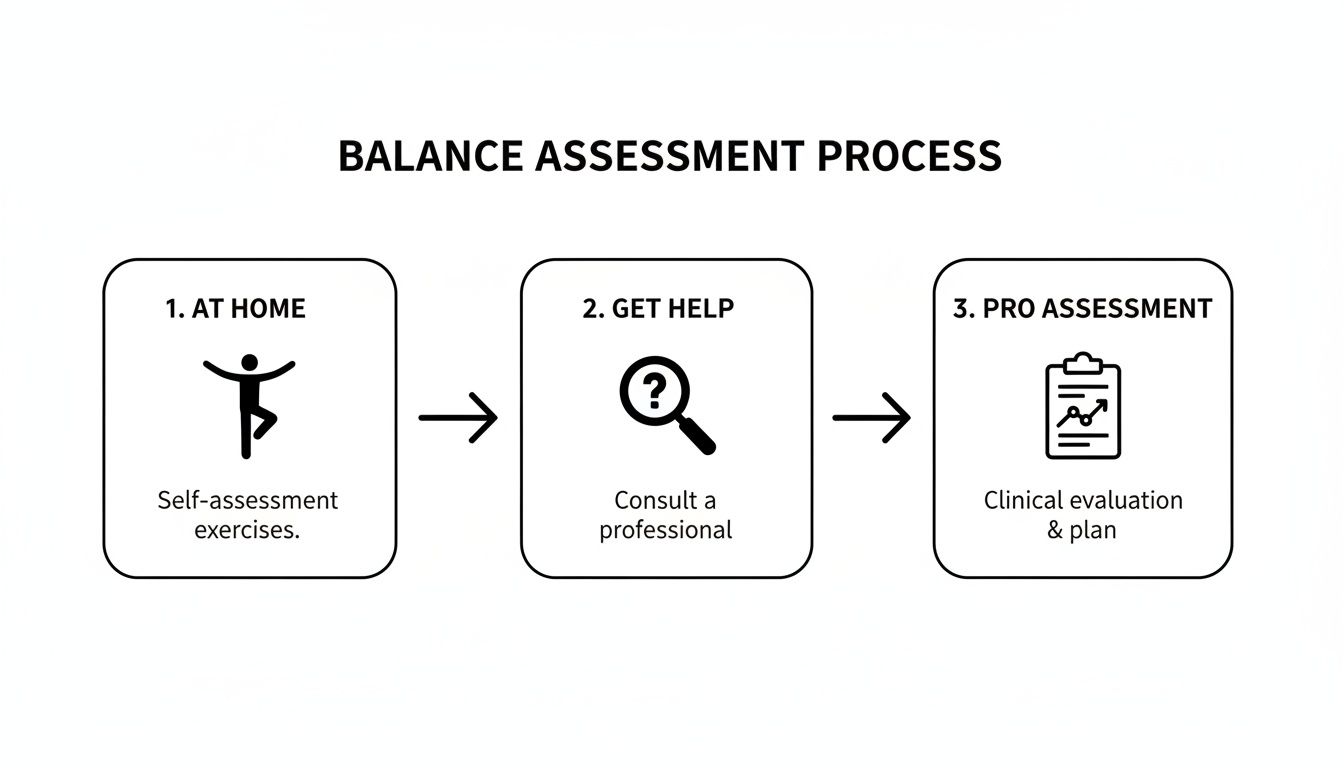
This process highlights a key truth: while you can start improving at home, a professional assessment is what creates a truly personalized and effective plan for real-world stability.
The Power of Proprioception and Uneven Surfaces
Have you ever wondered how you know where your feet are without looking down? That’s proprioception, your body’s built-in "sixth sense." It’s how your muscles and joints communicate their position to your brain. This sense can get a little dull with age, which is why walking on soft grass or a plush carpet can suddenly feel challenging. We can sharpen it by practicing on purpose-built unstable surfaces.
You can start right at home with a pillow or a folded bath towel.
- Hold onto a counter for support and simply try standing on one leg on the soft surface.
- You'll feel the small muscles in your ankles and feet firing up to keep you steady. This is exactly what we want!
- As you improve, try marching in place or even taking slow, deliberate tandem steps across the pillow.
After practicing this for a bit, walking on a normal, flat floor will feel remarkably easier and more secure. For those who need an even gentler way to challenge this system with almost no stress on the joints, the benefits of aquatic physical therapy in a pool are fantastic, as water provides both support and natural resistance.
And the science backs this up. Research shows that practicing movements that mimic daily life—what experts call functional-task training—is far more effective than just general strengthening. In one 12-week study, a group doing functional exercises improved their Berg Balance Scale score by over 10%, while a group doing only resistance training improved by less than 3%. The functional group also saw their Timed Up and Go test score improve by 14.94%—more than double the 7.37% gain seen in the other group. It’s clear proof that practicing for the real world gets you real-world results.
Creating a Fall-Proof Home Environment
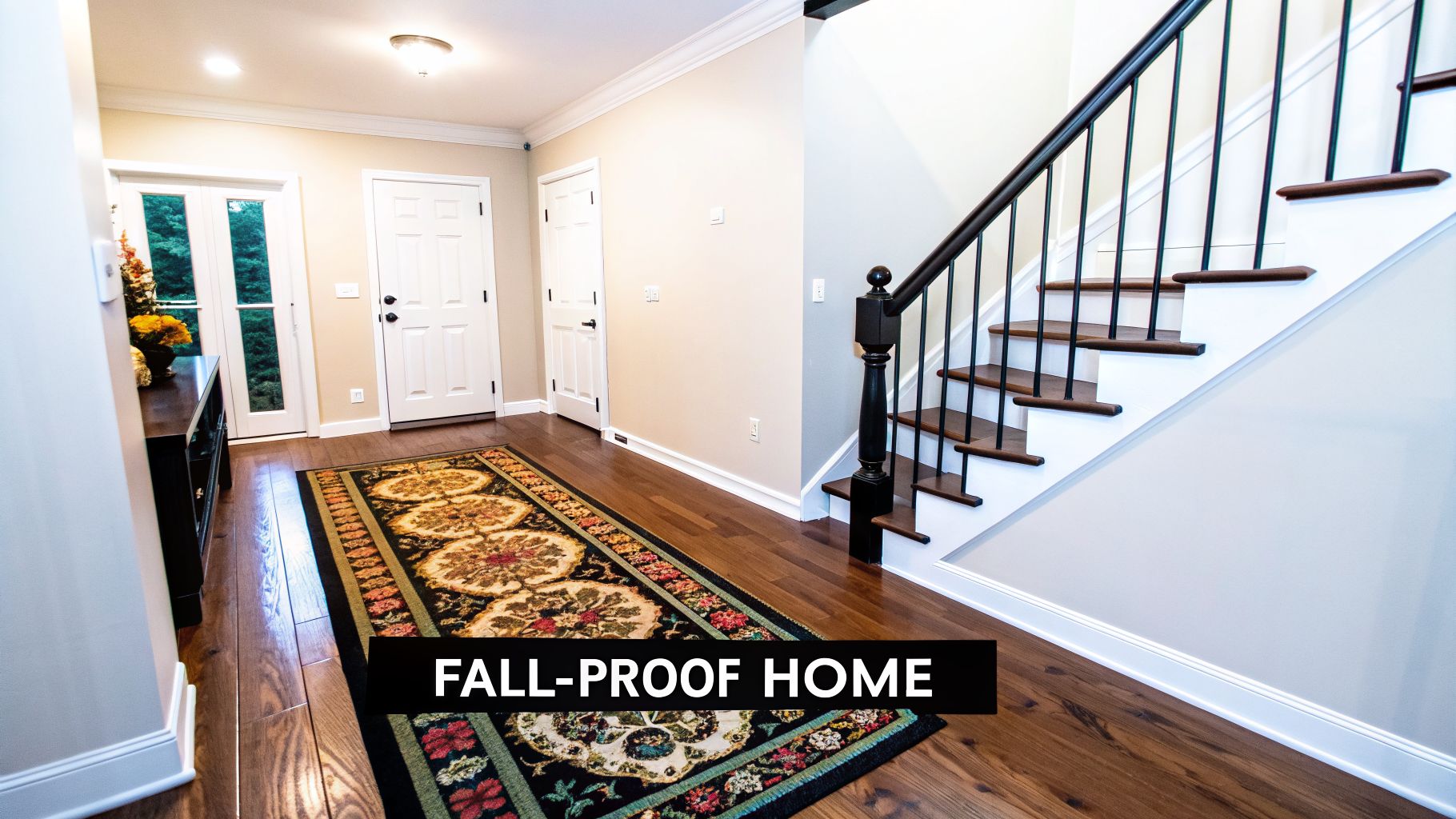
While the exercises in this guide build your internal stability, your home environment is your first line of defense. All the balance training in the world won't help if you trip over a loose rug or a poorly placed cord.
Making a few smart, simple changes to your home can dramatically lower your fall risk. It’s not about bubble-wrapping your life; it’s about giving you the confidence to move freely and independently in your own space.
Clearing Your Path
The most preventable falls almost always start with one thing: clutter. A clear path is a safe path. It’s time to take an honest walk through your home and spot the trip hazards before they become a problem.
- Rethink the Rugs: Throw rugs are notorious for causing falls. Their edges curl, and they slide easily. If you can’t part with them, use double-sided carpet tape to secure every single edge and corner firmly to the floor. No exceptions.
- Tame the Cords: Electrical cords snaking across a walkway are a major hazard. Take a few minutes to reroute them along the walls or use inexpensive cord covers to tape them down flat.
- Declutter Traffic Zones: Hallways, staircases, and the main paths between rooms need to be completely clear. Make it a new house rule: no shoes, bags, or stacks of mail left on the floor.
Let There Be (Safe) Light
You can't avoid what you can't see. Poor lighting, especially at night, hides obstacles and disorients you. Many falls happen during that nighttime trip to the bathroom.
This is one of the easiest fixes. Install plug-in, motion-activated night lights in your bedroom, hallways, and bathroom. They provide instant, hands-free light the moment you get up, so you’re not fumbling for a switch in the dark. Also, make sure a lamp is always within easy reach of your bed.
Tackling Kitchen and Bathroom Hotspots
Statistically, the bathroom is one of the most dangerous rooms in the house. The combination of water and hard, slick surfaces is a recipe for disaster. The kitchen isn't far behind, with its potential for spills and the need to reach for items.
In the bathroom, put non-slip mats both inside the shower and on the floor outside of it. Sturdy, properly installed grab bars near the toilet and in the shower are non-negotiable—they provide a critical handhold when sitting, standing, or stepping over a tub ledge. For a truly safe space, you can even explore options for safe, accessible bathrooms for seniors that remove high barriers altogether.
The kitchen is all about smart organization and habits:
- Move your most-used items—plates, glasses, coffee mugs, common spices—to lower, easy-to-reach shelves. This simple change eliminates the need to climb on a step stool.
- Clean up all spills the second they happen. A small puddle can create a dangerously slick spot.
- Ditch the flimsy slippers or socks. Wear supportive shoes with a good grip, even indoors. They provide far better traction on tile and hardwood floors.
To help you get started, we've put together a quick checklist for the most common problem areas in any home.
Home Safety Hotspot Checklist
Use this table to do a quick safety audit of your own space. Go room by room and see what simple fixes you can make today.
| Room/Area | Common Hazard | Simple Fix |
|---|---|---|
| Hallways/Stairs | Clutter, poor lighting, loose runners | Clear all items, add night lights, secure stair runners. |
| Living Room | Throw rugs, electrical cords, low furniture | Remove or tape down rugs, use cord covers, ensure clear paths. |
| Bedroom | Dark path to bathroom, clutter by bed | Add a bedside lamp & night lights, keep floor clear. |
| Bathroom | Slippery tub/floor, no support | Use non-slip mats, install grab bars by toilet & shower. |
| Kitchen | Spills, items stored up high | Clean spills immediately, move daily items to low shelves. |
Each little fix you make adds up, creating a home that supports your stability and helps you stay active and independent for years to come.
When to Partner with a Physical Therapist
While at-home exercises and safety updates are fantastic first steps, there comes a time when you need an expert in your corner. Seeing a physical therapist isn't a sign of weakness—it's a smart, proactive move to get to the root of your balance problems and stay independent for the long haul.
Sometimes, the signs are impossible to ignore. If you’ve had a fall, even a small one that didn't seem like a big deal, that’s your cue to call a professional. A fall is a serious event, and it unfortunately makes you much more likely to fall again. A therapist can help you break that cycle for good.
Other times, the signals are more subtle. Maybe it's a nagging feeling of being unsteady on your feet, or you find yourself hesitating before walking across a busy parking lot or an uneven lawn. If you're managing a condition like Parkinson's, arthritis, or peripheral neuropathy, working with a therapist who understands its specific impact on your balance is crucial.
What to Expect from Your First Visit
Your first visit isn’t about jumping into a tough workout. It’s all about diagnosis. At a clinic like MedAmerica Rehab Center, a therapist's main goal is to become a detective, piecing together the clues to understand why you feel unsteady.
This comprehensive assessment usually involves a few key parts:
- A Detailed Conversation: Your therapist will want to know your full story—your health history, any falls you've had, what medications you take, and the specific moments when you feel most off-balance.
- Official Balance Tests: They'll use proven tools like the Berg Balance Scale or the Timed Up and Go (TUG) test. These give a clear, objective score of your stability, creating a baseline we can work to improve.
- Gait Analysis: You'll be asked to walk while the therapist observes everything from your stride length to your posture. They're looking for subtle patterns that could be throwing you off.
- Strength and Flexibility Checks: This helps pinpoint any muscle weakness or joint stiffness that’s contributing to the problem.
This thorough evaluation lets the therapist see the whole picture. They can figure out if the issue is coming from weak legs, an inner ear problem, or poor feedback from the nerves in your feet.
A physical therapist provides more than just a list of exercises. They offer one-on-one guidance, correcting your form in real-time to ensure you're performing movements safely and effectively for maximum benefit.
The Advantage of a Professional Program
One of the biggest benefits of guided therapy is having access to specialized equipment and a plan that grows with you. You might work with tools like balance boards, foam pads, or even virtual reality systems that safely challenge your stability in ways you just can't at home. A therapist knows exactly when to dial up the difficulty to keep you making progress without putting you at risk.
Consistency is also a huge factor. Meaningful change takes time and dedication. In fact, a large-scale analysis found that the most effective balance programs involved sessions lasting over 30 minutes, held at least three times a week for a minimum of 24 weeks. As you can read in the full study about balance interventions, sticking to that kind of schedule is much easier with the accountability and motivation of a structured therapy program.
If you feel like your home routine has stalled and you’re not seeing any more improvement, that’s the perfect time to get a professional opinion. A therapist can introduce new challenges to get you past that plateau. For those in the South Florida area, you can learn more about how physical therapy for seniors in Deerfield Beach can create a plan just for you. Taking that step is a powerful way to protect your independence and move through life with more confidence.
Common Questions About Improving Senior Balance
When you start thinking about improving your balance, it’s only natural for questions to pop up. We hear them every day at MedAmerica Rehab Center. Concerns about how long it takes, what to expect, and how to help a loved one are completely normal. Let's walk through some of the most common questions to give you a clearer path forward.
How Long Does It Take to See Improvements?
This is the big one, and the honest answer is: it depends. But the most important factor is consistency. While some people start to feel a bit steadier within a few weeks, real, lasting change takes a longer commitment.
Most research points to balance programs of at least 12 weeks to see clear, measurable gains. For the most significant and durable results, however, you're looking at programs that last 24 weeks or more, with exercise happening at least three times a week. It’s not about one killer workout; it’s about the steady rhythm of practice. A physical therapist is a huge help here, keeping you motivated and tracking your progress over the long haul.
Is It Ever Too Late to Start Balance Training?
Absolutely not. We’ve had the privilege of seeing clients in their 80s and even 90s make incredible progress at our Deerfield Beach clinic. It is never too late to build strength and improve your balance, whether you’re 65 or 95.
Your body has a remarkable ability to adapt at any age. While it might take a little longer to wake up those muscles and nerve pathways, the most important thing you can do is simply begin. A professionally guided program is key here, as it ensures every exercise is safe and perfectly matched to where you are today.
Key Takeaway: The fear of falling is a huge barrier, but it’s inactivity that makes balance worse. The solution is to start small in a safe space, building confidence with small wins.
What Is the Difference Between Dizziness and a Balance Problem?
This is a critical distinction, because the right treatment starts with the right diagnosis. They can feel connected, but they often have different roots.
- Dizziness usually feels like a spinning sensation, which is called vertigo. This feeling is often tied to your vestibular system—the delicate structures in your inner ear that sense head movement.
- A Balance Problem, or disequilibrium, is more of an unsteady, off-kilter feeling, like you’re about to lose your footing. This can come from many sources, including weak muscles, poor vision, or nerve damage in the feet (neuropathy).
The two can definitely overlap, which is why a professional assessment is so valuable. A physical therapist can run specific tests to pinpoint the primary cause and create a targeted plan, whether that’s vestibular rehab for vertigo or strength training for disequilibrium.
How Can I Encourage a Parent Who Is Afraid of Falling?
Fear of falling is a powerful emotion that can trap someone in a dangerous cycle. The fear leads to less activity, which makes strength and balance worse, which only makes the fear stronger. The best way to help is with empathy and by starting small.
Suggest simple, seated exercises they can do, or movements while holding onto a sturdy kitchen counter. The goal is to create small, successful steps that prove movement can be safe. This helps rebuild their confidence one bit at a time.
Often, bringing in a professional is the most effective way forward. A consultation with a physical therapist can be incredibly reassuring. The secure, controlled environment of a clinic, guided by an expert, is often the perfect combination to help them overcome that fear and feel in control again.
At MedAmerica Rehab Center, our therapists specialize in creating personalized balance and fall prevention programs that build strength, confidence, and independence. If you or a loved one are ready to take that next step toward better balance, visit us online to schedule your initial assessment.