
Boost Senior Safety: Fall Prevention Exercises for Seniors
Feeling steady on your feet is the foundation of an active, independent life. The best fall prevention exercises for seniors zero in on three key areas: building strength in your legs and core, sharpening your balance, and improving your flexibility. Together, they make you far more resilient to the trips and stumbles of daily life.
Why Fall Prevention Is Key to Senior Independence
For many older adults, the thought of falling becomes a constant, nagging worry. This fear isn't just about getting hurt; it’s what causes you to turn down a walk in the park or hesitate to get on the floor to play with your grandkids. Proactive fall prevention isn't really about avoiding a hospital visit—it's about holding onto your freedom and confidence.
The numbers show just how common this issue is. Every year, more than one in four adults aged 65 and older will fall. The real problem is that falling once doubles your risk of falling again. It’s a tough cycle to break.
This cycle of fear is a huge challenge. After a fall, or even a close call, it’s only natural to become more cautious. But when you move less, your muscles get weaker and your balance suffers, which ironically makes another fall even more likely.
To get a better sense of your own situation, take a moment to review this quick checklist. It helps highlight common factors we see every day in the clinic.
Quick Fall Risk Self-Assessment Checklist
| Risk Factor | Check if 'Yes' |
|---|---|
| Have you fallen in the past year? | |
| Do you feel unsteady when walking? | |
| Do you worry about falling? | |
| Do you use your hands to push up from a chair? | |
| Do you sometimes feel dizzy or lightheaded? | |
| Do you take four or more prescription medications? | |
| Do you have numbness in your feet? | |
| Do you hurry to the toilet during the day or night? |
Seeing a few checks in that 'Yes' column is exactly why taking action is so powerful. You have the ability to change the outcome.
Taking Back Control and Building Confidence
Here’s the most important truth: falls are not an inevitable part of getting older. You can take direct control by strengthening your body’s built-in defense system against unexpected slips and trips.
Building Strength: Strong leg and core muscles are your anchor. They give you the power to get up from a deep sofa without help, to catch your balance if you trip over a curb, and to climb stairs without a second thought.
Improving Balance: Balance drills are like tuning up your body's internal GPS. This training helps you stay stable while walking on uneven surfaces, like a grassy lawn or a cracked sidewalk in your Deerfield Beach neighborhood.
Enhancing Flexibility: Good range of motion in your ankles, knees, and hips allows your body to react quickly. It’s what lets you bend over to tie your shoes or reach for something on a high shelf without losing your footing.
A truly independent lifestyle comes from a holistic approach. This means also understanding the role of podiatry in maintaining mobility as you age, because healthy feet are the very platform you stand on. When your feet are strong and pain-free, your entire body is better prepared to stay balanced and upright.
The Pillars of Stability: Strength, Balance, and Flexibility
Think of your ability to stay steady on your feet like a three-legged stool. If one leg is short or weak, the whole stool becomes wobbly and unreliable. The same goes for your body. A solid fall prevention plan is built on three essential "legs": strength, balance, and flexibility.
Each one plays a unique and critical role. When you work on all three together, you create a powerful defense against slips, trips, and unexpected tumbles. These aren't just gym terms; they are the skills your body uses every single moment to keep you upright and moving confidently.
The Power of Foundational Strength
Strength is your body's engine. It's the force that gets you out of a deep sofa, helps you carry a heavy laundry basket, and—most importantly—allows you to catch yourself if you stumble. For fall prevention, we focus on two main areas:
Leg Strength: Your major leg muscles (quadriceps, hamstrings, and glutes) are your powerhouses. Strong legs give you the oomph to climb stairs, stand up from the floor, and stop a fall in its tracks. Picture stepping off a curb you didn't see; it's your leg muscles that fire instantly to keep you from going down.
Core Strength: Your core is everything from your abs and obliques to your lower back. It's the vital link between your upper and lower body. A strong core acts like a natural corset, keeping your torso stable and solid as you move.
A stable core is non-negotiable for maintaining good posture and balance, especially when you're in motion. We have a great guide with more tips and specific exercises right here: how to strengthen your core with these exercises.
Honing Your Sense of Balance
True balance is much more than just standing still on one foot. It’s a complex skill that relies on a system called proprioception—basically, your body's internal GPS. This sense tells your brain where your arms and legs are in space without you having to look down. It’s what lets you navigate a dark room without bumping into the furniture.
As we get older, our proprioception can get a little fuzzy, making us rely more heavily on our vision to stay steady. This is why a simple distraction or a poorly lit area can sometimes lead to a stumble.
Targeted balance exercises work to retrain this sense. By challenging your stability in a safe and controlled way, you’re essentially recalibrating your body's internal GPS so it can react faster and more accurately when you need it most.
Think about working in the garden. You might be kneeling, then reaching for a trowel, then standing back up, all on soft, uneven dirt. Good balance lets you flow through these movements without a second thought.
The Necessity of Everyday Flexibility
Flexibility is the pillar that gives you fluid, adaptable movement. It’s all about the range of motion in your joints, especially in your hips and ankles. Good flexibility allows your body to move freely and navigate the world around you.
Consider these real-life moments:
- Ankle Flexibility: When your ankles are flexible, your feet can easily adapt to uneven ground, like a grassy hill or a cracked sidewalk. If your ankles are stiff, you're far more likely to roll an ankle, which can easily lead to a fall.
- Hip Flexibility: Mobile hips allow you to step over an obstacle, swing your leg to get out of a car, or bend down to tie your shoe without losing your balance or straining your back.
When your body lacks flexibility, your movements become stiff and choppy. You lose the ability to make the small, lightning-fast adjustments needed to stay upright when the unexpected happens.
These three pillars—strength, balance, and flexibility—don't work alone. They're a team. Improving one almost always helps the others, creating a positive upward spiral of stability, confidence, and safety.
Your Foundational Fall Prevention Exercise Program
Alright, let's get moving. Theory is one thing, but purposeful movement is what builds real-world stability and the confidence that comes with it. Here, we'll walk through the foundational fall prevention exercises for seniors you can start today, with nothing more than a solid chair.
We won’t just show you how to do an exercise; we'll explain why it matters. When you understand that a simple Wall Push-Up helps you get up from the floor, every repetition feels more valuable. Always put safety first—keep a sturdy chair or countertop within arm's reach for support.
These exercises are built on three pillars that work together to create a solid base for confident movement.
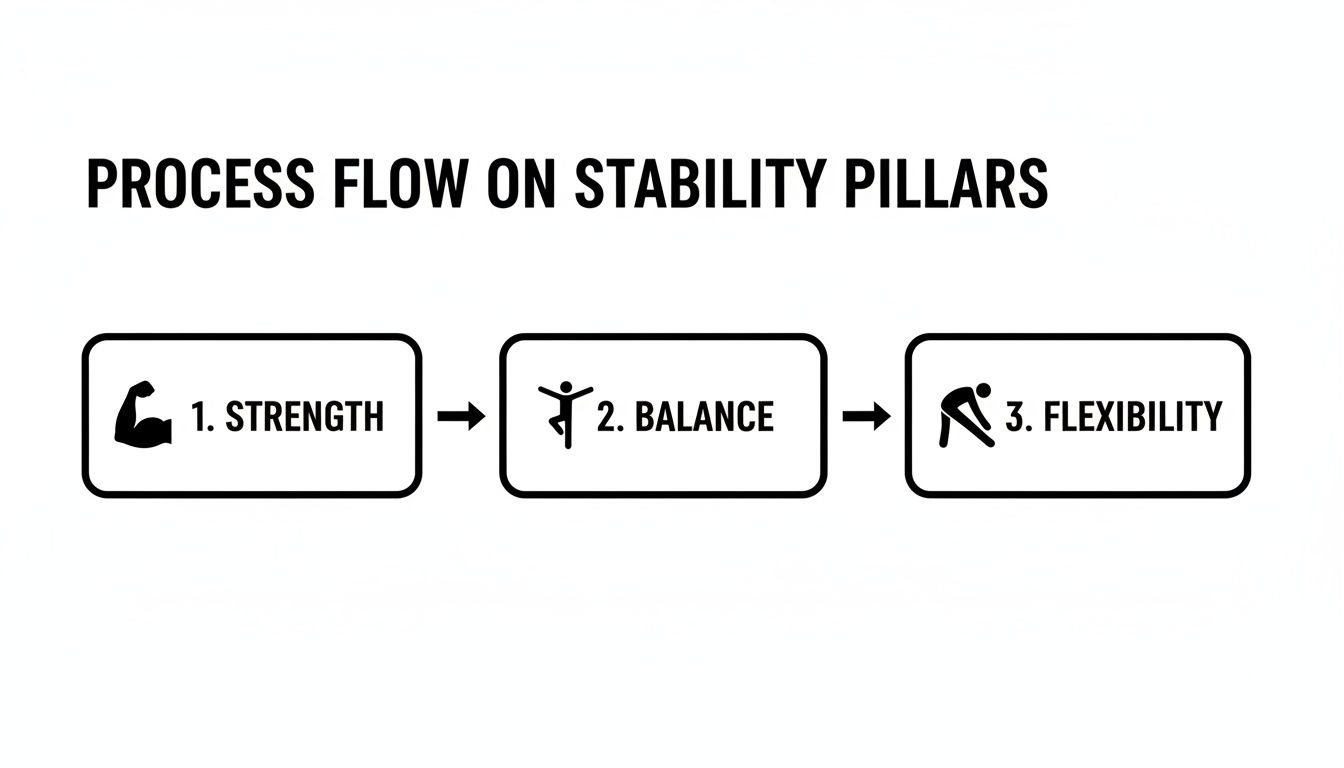
Think of it this way: each pillar supports the others. When your legs are strong, your balance improves. When you're flexible, you can move with more control. It's a powerful combination.
Chair Squats for Leg and Core Power
Chair Squats build the strength you need to stand up from a low couch, climb stairs without hesitation, and stay steady after a stumble. They directly target the big muscles in your legs (quadriceps, hamstrings) and your glutes.
To get started, stand in front of a sturdy, armless chair with your feet about shoulder-width apart. Extend your arms out for balance. Now, slowly bend your knees and push your hips back like you’re about to sit down, keeping your chest lifted. Just before you touch the chair, push through your heels and return to standing.
A good goal is 2 sets of 10 repetitions.
Safety & Progression: When you're just starting, go ahead and sit down completely between each squat. As you feel stronger, try to just hover an inch above the seat. For an extra challenge, you can hold light weights or even a jug of water.
Wall Push-Ups for Upper Body Resilience
One of the most critical skills for maintaining independence is having the strength to push yourself up from the floor after a fall. Wall Push-Ups build this exact strength in your chest, shoulders, and arms, but without the strain of a traditional push-up.
Stand facing a wall, about an arm's length away, and place your palms flat on it at shoulder height. Keeping your back straight, slowly bend your elbows and lean your body toward the wall. Then, push back to your starting position. This movement directly translates to real-world function.
Try to complete 2 sets of 10-12 repetitions.
Single-Leg Stands to Sharpen Balance
This is one of the best ways to improve your balance. It helps retrain your body's proprioception—its own internal GPS system. Every time you walk, you're briefly balancing on one leg, which makes practicing this move so important.
Stand behind a sturdy chair, holding on with both hands. Shift your weight to your right foot and slowly lift your left foot just a few inches off the floor. Hold for 10-15 seconds, keeping your eyes on a fixed spot in front of you. Lower your foot and switch to the other side. Aim for 3 repetitions on each leg.
As you get steadier, you can make it more challenging:
- First, try holding on with just one hand.
- Then, try balancing with only one fingertip on the chair.
- Finally, see if you can balance with no hands, keeping them hovering just above the chair for safety.
This kind of focused practice really works. A major analysis confirmed that programs with balance and functional exercises can reduce falls by a whopping 24%. This is because they improve coordination and your body's sense of where it is in space. You can discover more about how targeted exercises reduce fall rates in older adults in recent studies, showing just how protective this training can be.
Tandem Stance for Walking Stability
The Tandem Stance, or heel-to-toe position, mimics the act of walking and challenges your balance in a way that prepares you for uneven ground or narrow hallways.
Stand next to a wall or countertop for light support. Place the heel of one foot directly in front of the toes of the other, like you're on a tightrope. Hold this position for 20-30 seconds, then switch feet and repeat.
Once that feels comfortable, try taking 10 slow, deliberate steps forward in this heel-to-toe pattern. This is how you improve your dynamic balance—the kind you need when you're actually on the move.
Heel and Toe Raises for Ankle Strength
Your ankles are your first responders when you trip. Strong, mobile ankles react quickly to uneven surfaces, which can stop a stumble from becoming a fall.
Heel Raises (for calf strength):
- Stand behind your chair, holding on for support.
- Slowly rise up onto your tiptoes, pause for a second, and then slowly lower your heels back down.
- Perform 2 sets of 15 repetitions.
Toe Raises (for shin strength):
- From the same starting position, rock back on your heels and lift your toes off the floor.
- Hold the position briefly before lowering your toes.
- Perform 2 sets of 15 repetitions.
These might seem like small movements, but they're vital for all the tiny adjustments your feet make with every single step. If you're dealing with joint pain that makes these land-based exercises tough, there are other great options. In fact, you might be interested in the benefits of aquatic therapy for joint-friendly exercise, which can be a perfect complement to what you do at home.
Building a Consistent and Motivating Weekly Routine
Knowing the right exercises is only half the battle. The real secret to building lasting stability is consistency.
Making these movements a regular part of your life is what truly builds the strength and balance you can rely on day in and day out. Think of it less as a chore and more as a daily investment in your own independence.
A simple plan removes the guesswork. It helps you stick with it, even on days when you’re feeling a bit tired or unmotivated. You're making an appointment with yourself—and it's one of the most important ones you can keep.
Creating Your Weekly Blueprint
A good routine isn't about doing everything, every day. It's about balance. By mixing up your focus between strength, balance, and flexibility, you give your muscles time to recover and get stronger, and you keep things from getting stale.
And remember, rest days are just as important as activity. A rest day doesn't have to mean sitting on the couch; a gentle walk or some light stretching can be perfect for "active recovery."
Here’s a sample schedule to get you started. Think of it as a template—feel free to move days around to fit your life and energy levels.
Sample Weekly Fall Prevention Exercise Schedule
The key is to aim for about 20-30 minutes of focused exercise on your activity days.
| Day | Focus | Sample Exercises | Duration |
|---|---|---|---|
| Monday | Strength | Chair Squats, Wall Push-Ups, Step-Ups | 20-30 Mins |
| Tuesday | Balance & Flexibility | Single-Leg Stands, Tandem Walking, Calf Stretches | 20-30 Mins |
| Wednesday | Active Rest | Gentle walking, light gardening, or stretching | 20+ Mins |
| Thursday | Strength | Chair Squats (progress to no hands), Wall Push-Ups, Marching in Place | 20-30 Mins |
| Friday | Balance & Flexibility | Tandem Stance, Heel-to-Toe Walking, Ankle Rotations | 20-30 Mins |
| Saturday | Fun Activity | Dancing, walking with a friend, a group fitness class | 30+ Mins |
| Sunday | Rest | Full rest or very light stretching | As needed |
This structure ensures you're building a well-rounded foundation for stability without overdoing it.
Staying Motivated When Life Gets in the Way
Some days, you just won't feel like it. Maybe you’re a little stiff, your energy is low, or the routine just feels… well, routine. That’s completely normal. The trick isn't to force it, but to have a few strategies ready for those moments.
The most effective exercise routine is the one you actually stick with. Don’t worry about perfection. If you miss a day, just get back to it the next. It’s the long-term pattern of activity that delivers life-changing results.
Here are a few practical tips our therapists share with patients:
Break It Up: Feeling overwhelmed by a 20-minute session? Split it. Do 10 minutes of heel raises and marching while your coffee brews, then 10 minutes of chair squats during a commercial break later. Every bit counts.
Find a Partner: Working out with a friend, spouse, or family member is a game-changer. It creates natural accountability and makes the whole process more fun.
Track Your Progress: Use a simple notebook to jot down what you did. Seeing how much stronger you've gotten over a few weeks is one of the best motivators there is.
To build a routine that lasts, it helps to understand the psychology of habit. Learning how to stay consistent with your exercise program can make all the difference.
Celebrate Your Victories, Big and Small
Don't forget to acknowledge your hard work. Did you hold your balance for 5 seconds longer than last week? That’s a huge win! Did you stick to your schedule three days this week? Awesome!
Celebrating these small milestones builds momentum and reinforces the powerful, positive changes you're making. You're not just doing exercises; you're actively building a safer, more confident future for yourself.
When to Seek Professional Guidance for Your Safety
Starting a home program of fall prevention exercises for seniors is a fantastic move toward better stability and confidence. But even the best DIY routine has its limits. Your body has ways of telling you when it's time to bring in an expert.
It's a lot like taking care of a car. You can check the tire pressure and top off the fluids yourself. But when you hear a strange engine noise or the brakes feel off, you head straight to a mechanic. Your body absolutely deserves that same level of expert care when red flags pop up.
Recognizing the Signs You Need a Professional Eye
Knowing when to switch from doing it yourself to getting professional help is one of the smartest things you can do for your safety. It’s not about failing—it’s about getting more personalized and effective care. You should seriously think about getting an evaluation if you notice any of these signs:
- You feel dizzy or lightheaded during exercises. This could point to issues with your blood pressure, inner ear, or other systems that a physical therapist is trained to spot.
- You have a history of multiple falls. If you've fallen more than once in the past year, there might be deeper gait or balance issues that need a full assessment to correct properly.
- You're managing a complex medical condition. Things like peripheral neuropathy (numbness in your feet), Parkinson's disease, significant arthritis, or vision problems can throw your balance off in ways that require very specific exercise modifications.
- You experience persistent pain. Pushing through pain in your joints or back is never the right answer. A professional can change your routine to help you get stronger without making things worse.
Seeking professional help is about creating a safety net. It’s about partnering with an expert who can fine-tune your program, correct your form, and give you the confidence to move safely and effectively.
What to Expect from a Professional Evaluation
Walking into a clinic like MedAmerica Rehab Center for a balance assessment is an empowering first step. A licensed physical therapist does so much more than just hand you a list of exercises. They take a deep dive into how you move.
The therapist will start with a thorough chat about your health history, any medications you take, and the details of any past falls. Then comes the hands-on evaluation, which might include:
- Gait Analysis: The therapist will watch you walk, looking at everything from your stride length and speed to any subtle imbalances.
- Balance Testing: This involves a series of standardized tests to measure your balance both when you're standing still (static) and when you're moving (dynamic).
- Strength and Flexibility Measurement: They’ll assess key muscle groups and your joint range of motion to find any specific weak spots or limitations.
Based on what they find, you get a plan that's built just for you. Structured programs with fall-prevention exercises like Tai Chi and resistance training have been proven to cut the rate of repeat falls by up to 50%. A detailed analysis confirms that professionally guided programs meaningfully reduce injurious falls—a critical outcome given their role in causing hip fractures and traumatic brain injuries in older adults. You can learn more about the impact of these expert-led programs from recent studies.
This personalized approach makes sure you're doing the right exercises, the right way, for your unique body. If you want to see what this looks like in practice, you can read about our approach to physical therapy for seniors in Deerfield Beach. Working with a professional gives you a clear, safe, and effective path to better balance.
Common Questions About Senior Fall Prevention
Starting any new exercise plan can feel like a big step, and it’s completely normal to have questions. Getting clear answers helps build the confidence you need to stick with it. Let's walk through some of the most common things we hear from people just like you.
Think of this as your practical guide to getting started on the right foot.
How Quickly Will I Notice a Difference?
This is one of the very first questions people ask, and the answer really comes down to consistency.
Within just a few weeks of regular practice, you’ll likely start to feel a bit steadier. That initial boost comes from your brain and body simply getting used to the new movements.
But for those significant, lasting gains in muscle strength and true balance, you’ll need a little more time. Most people notice a real, functional difference—like catching yourself from a stumble or getting out of a chair with ease—after about two to three months of consistent work.
It's not about quick fixes. Every single session adds up, building a stronger, more stable you.
What if I Have Knee or Back Pain?
Living with chronic aches and pains can make the idea of exercising feel intimidating. But the good news is that the right kind of movement is often a key part of the solution. The most important rule is to never push through sharp or increasing pain.
If you have sensitive knees or an achy back, you just need to modify the exercises. It’s simple to do.
- For squats: Don't feel like you have to go deep. A small, partial bend in the knees still wakes up your leg muscles without putting stress on your joints.
- For balance work: Always have a sturdy chair or countertop right next to you. This gives you the security to practice without the fear of falling.
The best advice we can give anyone with pain is to get a professional assessment. A physical therapist can look at your specific situation and design a plan that strengthens your body safely, without making your pain worse.
Is It Ever Too Late to Start Preventing Falls?
The answer here is a firm and absolute no. It is never, ever too late to improve your strength, balance, and stability.
Your body has an amazing ability to adapt and get stronger at any age, whether you’re 65 or 95.
Even small improvements can make a massive difference in your daily life and dramatically cut your risk of a fall. Every bit of strength you build and every ounce of balance you regain helps you protect your independence. The best time to start was yesterday, but the next best time is right now.
If you're dealing with pain, dizziness, or simply want the safest, most effective plan for your specific needs, the experts at MedAmerica Rehab Center are here to help. We can provide a complete assessment and create a personalized fall prevention program just for you. Contact us today to schedule your appointment.